
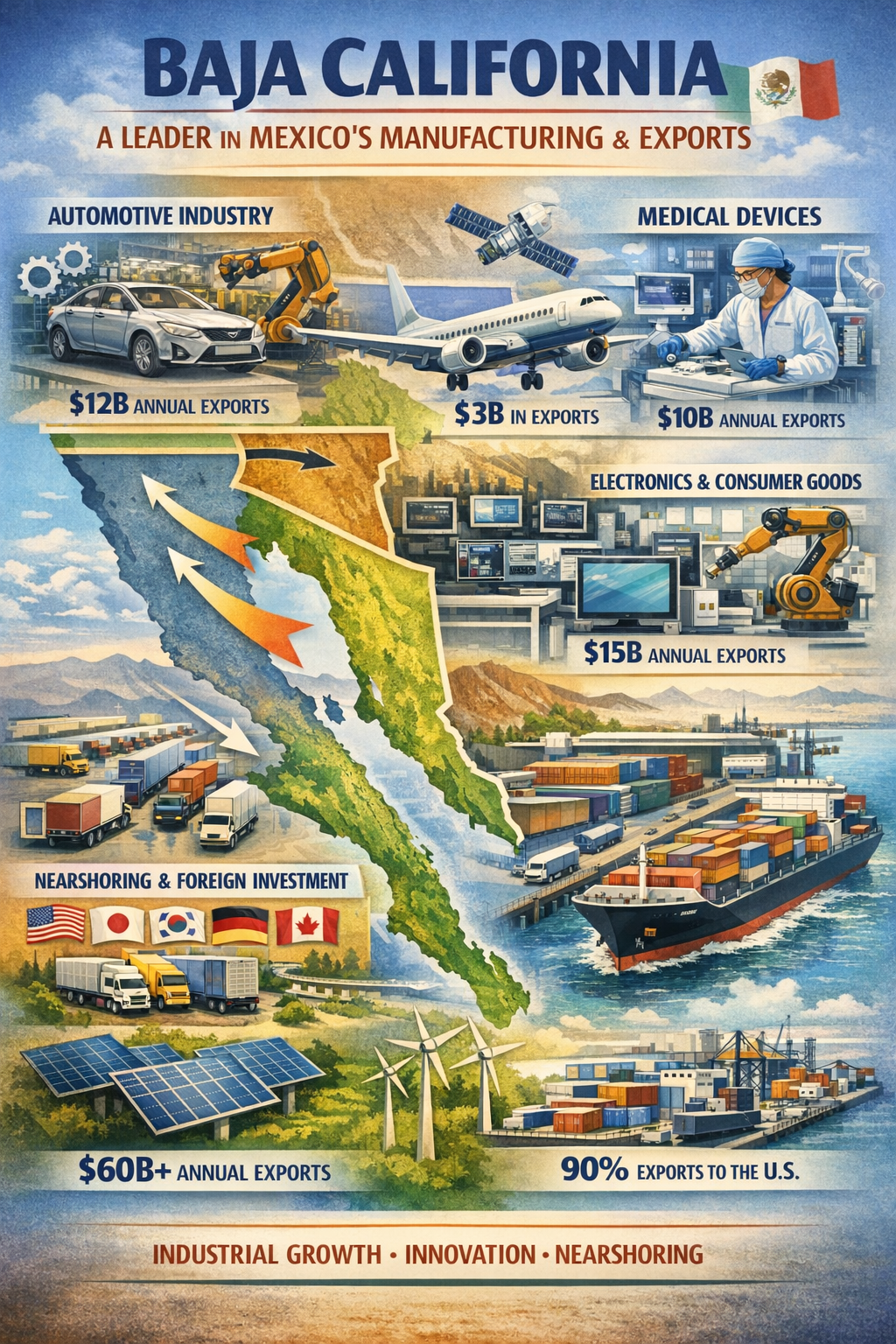
Baja California has emerged as one of Mexico’s fastest-growing and most competitive destinations for global capital, manufacturing, and innovation. In the third quarter of 2025, the state ranked in the top five nationwide in foreign direct investment (FDI), reaching over $1.8 billion invested YTD and placing fourth in Mexico. It has sustained investor confidence due to its diversified industrial base and strategic geographic position, which has allowed manufacturers to integrate into North American and global supply chains. While Mexico City, Nuevo León, and Querétaro have attracted significant attention and investment from multinational companies, investment in Baja California is also notable for the value-added complexity of its manufacturing sectors, forward-looking industries, and diversification of foreign capital sources.
Competitive Location and Industry Infrastructure Drive Investment
With one border state adjacent to California and several border crossings throughout Tijuana and Mexicali, as well as the Port of Ensenada linking Pacific Ocean trade with North America, geography is one of Baja California’s largest competitive advantages. More than 90% of Baja California’s exports are sold to the United States, illustrating the high level of cross-border production and supply chain integration between the two states.
Hosting more than 100 industrial parks and thousands of maquiladoras operating under export-based programs, the state has the infrastructure necessary to support just-in-time manufacturing models and same-day delivery to U.S.-based distribution centers. Lower transportation costs and inventory lead times are among the reasons investment in Baja California has become a cornerstone of Mexico’s nearshoring trend.
Automotive Manufacturing and Auto Parts: Powering Mexico’s Exports
Automotive and auto parts manufacturing is one of the largest sectors for investment in Baja California and contributes significantly to export totals. Over 250 automotive companies operate in Baja California, including auto part suppliers who manufacture wiring harnesses, electronic modules, interior systems, metal stampings, plastics, and more. Some of the largest automotive companies in the world operate facilities in Baja California to serve as Tier 1 and Tier 2 suppliers to automotive assemblers throughout Mexico and the United States.
Baja California’s annual automotive exports are estimated at over $12 billion, representing one of the largest shares of the state’s total exported manufacturing goods. As the global auto industry pivots toward electric vehicles, auto parts will continue to trend toward electric vehicle components, electronics, and lightweight materials. Expect investment in Baja California and its auto sector to grow in battery systems, power electronics, smart mobility, and other technologies as the electrification trend continues.
Aerospace: Advanced Manufacturing and Engineering
Aerospace represents another one of Baja California’s most lucrative and sophisticated industries. There are over 100 aerospace companies that operate throughout the state and employ tens of thousands of people in industries such as precision machining, aerospace composites, wiring systems, and aircraft assembly. Aerospace companies in Baja California produce parts sold and exported throughout the United States and generate over $3 billion in exports per year.
Companies based in the U.S., France, Canada, and the United Kingdom have made substantial investments in Mexicali and Tijuana to leverage certified labor and production costs while maintaining compliance with international standards such as AS9100. A number of companies also operate engineering and design centers in Baja California, allowing them to not only manufacture components but also become involved in product design and engineering. This helps raise the value-add of companies throughout the aerospace cluster.
Medical Devices and Life Sciences Manufacturing
Baja California, and more specifically, Tijuana has become one of the largest medical device manufacturing clusters in the world. With over 600 medtech companies producing surgical equipment, implants, diagnostic devices, catheters, and disposable medical goods, investment in Baja California in the medtech sector has generated exports worth over $10 billion annually. The majority of medical devices manufactured in Baja California are exported to the United States.
North American and European firms dominate this sector as they look to increase production capacity near end markets while taking advantage of regulatory expertise found in Mexico. The cluster represents a full ecosystem of contract manufacturers, sterilization centers, testing labs, packaging and logistics providers that work together to rapidly develop and scale medical technologies. Medical devices represent one of the fastest-growing segments of investment in Baja California as companies continue to innovate and introduce new technologies.
Electronics and Consumer Goods Production
Electronics manufacturing has been one of Baja California’s key industries for decades. Televisions, computer monitors, semiconductors, telecom equipment, and household appliances are among the many consumer goods produced in Baja California and sold to consumers throughout the world. Electronics account for some of the largest exports out of Baja California, totaling over $15 billion annually.
Japanese, South Korean, Taiwanese, and Chinese companies have all established a presence in Mexicali and Tijuana to source and produce goods for North American consumers. Benefiting from trade agreements such as the USMCA, the electronics cluster has also grown support industries such as plastic injection molding, metal finishing, packaging, and third-party logistics. New investments continue to target advanced electronics, automotive electronics, and industrial automation.
Growing Industries: Technology, Renewable Energy, Logistics
Aside from large-scale manufacturing, investment in Baja California is significant in technology service industries, renewable energy projects, and logistics. Located just miles away from one of the largest technology hubs in the world, California, Baja California has fostered cross-border collaboration in engineering services, software development, and R&D. Multinational companies have opened offices in Baja California to serve as engineering centers that support their global operations in automotive, aerospace, and consumer electronics.
Renewable energy is another sector that has started to pick up in recent years, with companies developing solar and wind energy projects to capitalize on natural resources and meet rising demand from industrial parks. Baja California receives some of the highest levels of sunlight per year in Mexico, creating a prime opportunity for solar farms. Warehouses, cold storage, and distribution facilities have also been on the rise as companies look to increase their cross-border trade volumes and participate in e-commerce.
Sources of Foreign Capital
The United States-Mexico border is the largest source of investment in Baja California by a significant margin. American companies account for the majority of investment across sectors such as medical devices, aerospace, automotive, electronics, and others. Due to its close proximity to the U.S. and established cross-border supply chains, numerous manufacturers view Baja California as an extension of their U.S. operations.
Asia is another important source of foreign capital for Baja California. Japan, South Korea, China, and Taiwan all have numerous companies with operations in Baja California. Japanese investment in Baja California dates back several decades with companies operating in the automotive and electronics sectors. South Korean investment has ramped up in recent years, with consumer electronics and home appliances leading the way. Chinese companies have also increased their presence in Baja California as trade tensions with the U.S. pushed companies to nearshore production and reduce overall supply chain risk.
European and Canadian companies have invested significantly in Baja California as well, with a particular focus on aerospace, automotive, and industrial equipment. Germany boasts some of the largest companies operating in auto parts and industrial machinery in Baja California. French and Canadian aerospace companies have made substantial investments in aerospace manufacturing and engineering services throughout the region.
Exports and Economic Contribution
Baja California is one of Mexico’s top exporting states, with total exports generating over $60 billion annually. Over 90% of those exports are manufactured goods, with electronics, automotive components, and medical devices leading the way. The United States serves as the end market for over 85% of Baja California’s exports.
Tens of thousands of employees work in industries that have been attracted to Baja California via foreign direct investment. Average wages are higher in these sectors as companies look to recruit and retain talent. Companies also provide ample opportunities for indirect employment through their supply chains. Local Mexican suppliers gain exposure to larger global companies by becoming part of their supply chains. Skill levels and training have increased as companies work with local universities and technical schools to develop programs tailored to their needs.
Public policy and investment in industrial infrastructure have also helped attract foreign capital and investment in Baja California. State and municipal governments have made strategic investments while streamlining permitting processes and improving access to workforce training programs. Coordinating with federal policymakers allows for alignment with national industrial policies as well as efforts to drive inclusive economic growth.
Looking Ahead: Baja California and Nearshoring
As global companies look to restructure supply chains and reduce risk, nearshoring opportunities will become even more prevalent. Companies are looking to mitigate geopolitical tensions, shorten lead times, and diversify their supplier bases by shifting production to nearby countries like Mexico. For Mexico, northern border states like Baja California will continue to be the top beneficiaries of nearshoring investment. Proximity to consumers, an established industry cluster, and an available workforce will ensure investment in Baja California remains strong in the coming years as companies continue to evolve their supply chain strategy.
Environmental Impact and Future Considerations
While industrial growth has brought substantial benefits to Baja California, there are hurdles that must be addressed to maintain momentum. From infrastructure to water scarcity, energy production, and urban development, there will need to be continued investments in Baja California to not only support its population but also its industrial ecosystem. Many companies are also evaluating ways to operate more sustainably, focusing on renewable energy, water reclamation, and circular economy initiatives.
Ensuring Mexico’s growth is enjoyed by everyone is another important goal for policymakers and business leaders. Although abundant opportunities exist in manufacturing, both companies and governments need to continue investing in education, skills training, and affordable housing.