
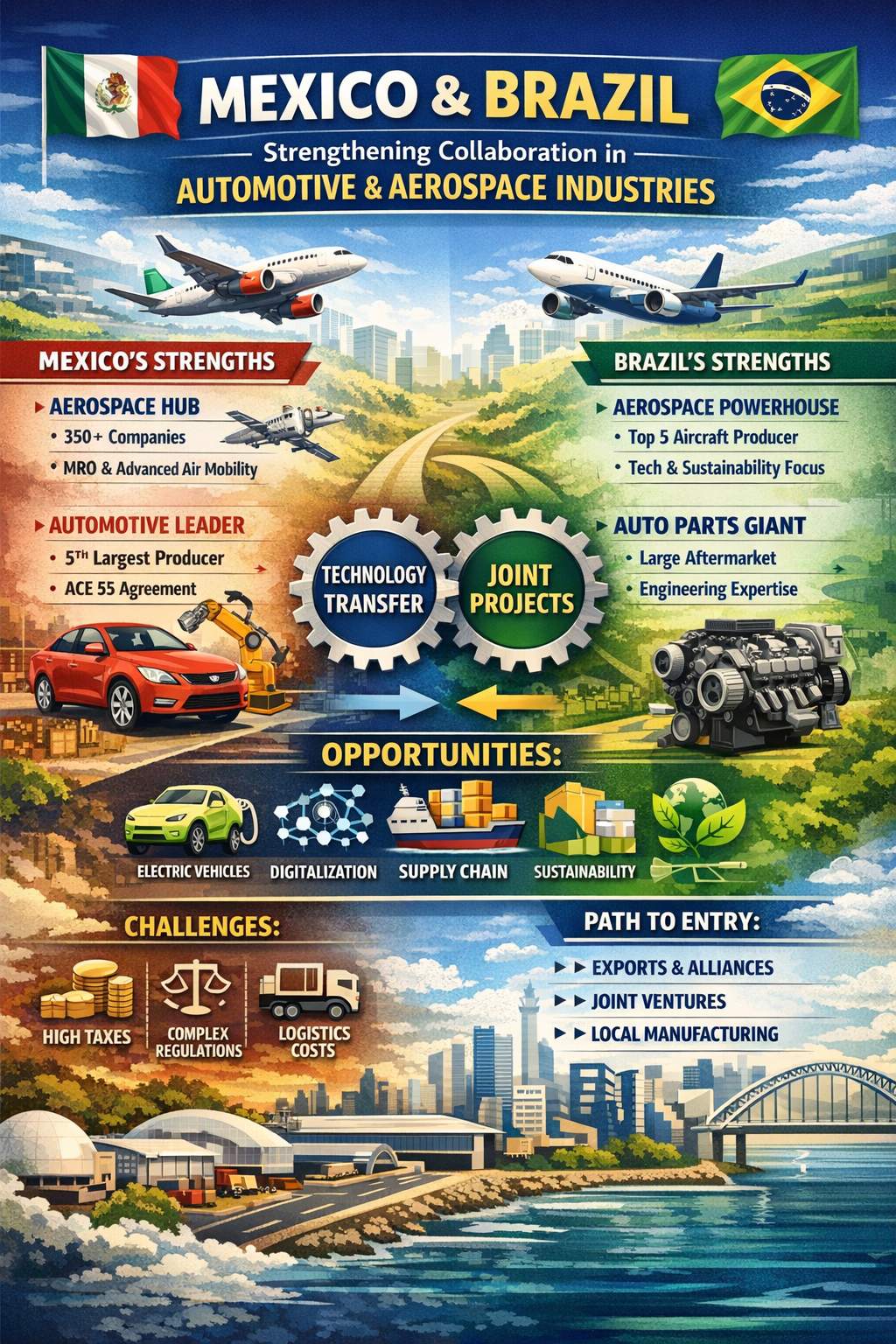
Brazil continues to position itself as one of Mexico’s main opportunities for industrial expansion, particularly when it comes to the automotive and aerospace industries. This premise was reinforced during the webinar “Opportunities for Access to the Brazilian Market” hosted by Mexico–Brazil Chamber of Commerce (CAMEBRA), where specialists agreed on the existing productive complementation possibilities between Latin America’s two largest economies and explained how Mexico and Brazil strengthen collaboration.
Moderated by Miguel Ruiz Luna, President of CAMEBRA, the webinar was conceived with the purpose of connecting Mexican producers and exporters to “Brazil, one of the main markets but also one of the most strategic and complex.” Ruiz Luna mentioned that understanding regulatory nuances, industrial dynamics, the tax system, and commercial culture is required knowledge to not only enter but also scale operations in Brazil. He also highlighted that cooperation between both nations goes beyond trade exchanges and includes technology transfers, investments, and joint industrial projects.
Mexico’s Aerospace Industry: Creating a Global Platform
In his presentation, Luis Lizcano, Executive President of the Mexican Aerospace Industry Federation (FEMIA), expressed how Mexico has become a powerful aerospace producer platform in less than two decades. FEMIA counts more than 350 companies specialized in aerospace; strong clusters have been developed in states like Querétaro, Chihuahua, Baja California, Sonora, and Nuevo León; and there is a high degree of integration with both North American and European supply chains.
Mexico’s aerospace industry exported USD 10.7 billion worth of goods and services in 2024, and it is projected to keep growing at a steady pace to reach around USD 19 billion by 2030. This is attributed to the increased demand for aircraft parts, engines, aerostructures, wiring interconnection systems, and maintenance, repair, and overhaul services. “Cooperation with Brazil will allow us to open strategic doors such as maintenance, repair, and overhaul (MRO); advanced air mobility; space; and supply chain diversification, among others,” Lizcano added. “All of these sectors gain importance when taking into consideration global geopolitics that involve reshoring, nearshoring, and the search for reliable, certified suppliers that can also compete on cost.”
“The great results come from great processes.” This quote by Lizcano refers to factors such as excellence in operations, certifications, and long-term industrial policies. Mexico and Brazil strengthen collaboration as Mexico can offer its OEMs and suppliers’ global value chain integration, while Brazil can offer technological strength and final assembly capabilities for aircraft.
Mexico’s Automotive Industry: Opportunities for Two Powerhouses to Complement Each Other
Automotive has made Mexico one of the largest producers globally. “Automotive represents around 32% of Mexico’s total exports,” said Dr. Alberto Bustamante, President of the National Association of Automotive Sector Suppliers (ANAPSA). This industrial sector has even surpassed oil and tourism when it comes to relevance. Right now, Mexico is the fifth-largest producer and exporter of light vehicles as well as the biggest exporter of heavy-duty trucks in the world.
Another fundamental point made by Bustamante is the Economic Complementation Agreement No. 55 (ACE 55), which benefits both Mexico and Brazil by eliminating tariffs between the nations in the automotive trade. Exchanges between Mexico and Brazil totaled over USD 66 billion in 2025. But it is not only finished vehicles that are impacted by ACE 55. The agreement enables deep integration between original equipment manufacturers (OEMs), Tier 1, Tier 2, and Tier 3 companies, logistics companies, engineering companies, and design companies.
Now more than ever it is strategic for Mexican automotive companies to connect with Brazil since the industry is undergoing major changes derived from the shift to electrification, increased digitalization, autonomous driving technologies, and more rigid environmental policies. By complementing each other, Mexico can offer competitively priced components, and Brazil can offer scale, engineering capabilities and access to South America.
Opportunities and Challenges to Enter the Brazilian Market
Gerson Secomandi, Vice President of Industrial Transformation for Latin America at ReThinkingWorks, provided insights from Brazil’s perspective. He mentioned that Brazil’s auto parts industry is one of Latin America’s largest, with a significant characteristic: its aftermarket. Parts required to maintain or repair a car account for almost 70% of total sales. This is largely due to Brazil’s vast vehicle fleet and long car ownership cycles.
The challenge with this industry is what Brazilians refer to as the “Brazil Cost”, which includes high taxes and a very complex tax system, bureaucratic customs operations, fragmented regulations, and high logistics and infrastructure costs. “All these challenges, however, are opportunities for companies that can bring efficiency, advanced manufacturing capabilities, lean processes, and technology,” Secomandi pointed out.
Companies that have experience with automation, digital transformation, ESG factors, and have proven processes to optimize cost structures are more likely to pursue entering Brazil through exports, alliances, or joint ventures. Setting up manufacturing facilities is also an option for Mexican companies wanting to do business in Brazil.
Brazil’s Aerospace Industry: Diversification, Technology, and Sustainability
Mathias Peter Hermann Mangels, President and Chief Revenue Officer of ReThinkingWorks, commented on Brazil’s aerospace industry, saying that Brazil is one of the five largest producers of commercial aircraft worldwide. “The aerospace industry in Brazil is mature, export-oriented, and supported by technological poles such as São José dos Campos, which harbors a large cluster of engineering firms, research institutions, and specialized companies.”
In aerospace, Brazil is looking to diversify its suppliers, implement advanced manufacturing technologies, and accelerate the adoption of digitalization and automation. Sustainability is a key priority as well, as there is an interest in reducing emissions and improving fuel economy. Mexican aerospace companies that are already EASA certified and have knowledge in global value chains will be able to provide value-added products and services.
Connecting Companies to Latin America’s Third Largest Economy
Manuel Reta with ATSC finished the webinar by presenting “Go to Market Brazil,” a methodology created by ReThinkingWorks to help companies enter Brazil. The methodology covers topics such as regulations, potential partners, localization, setting up operations, and more. It’s available in both book and online versions.
Go to Market Brazil offers companies a step-by-step guide to help them focus on reducing risk and accelerating entry into Brazil while organizing their internationalization process. This allows companies to not only strengthen bilateral ties but also learn what exact steps they should take, whether that be exporting, establishing a distribution agreement, or producing in Brazil.
Mexico and Brazil have more opportunities than just automotive and aerospace. Other industries with opportunities for collaboration include health and wellness, energy, beauty and cosmetics, advanced manufacturing, fintech, and professional services. Mexico–Brazil relations continue to strengthen to create a better Latin America and allow the region to compete on a global scale.