
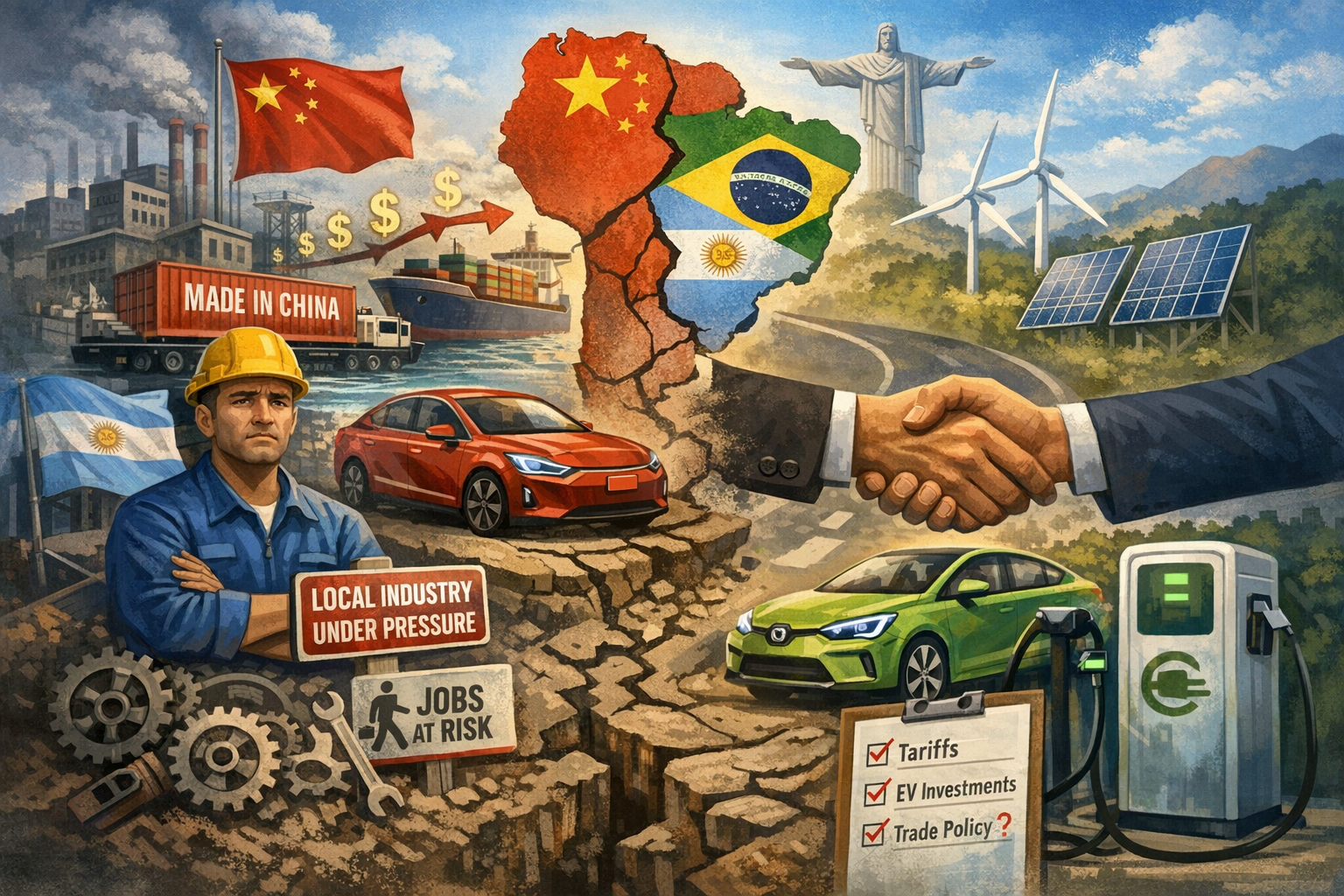
Chinese brands are on track to become the fastest-growing auto segment in South America in terms of market share. The impact they’re having locally not only affects sales but also production levels and jobs, as governments balance opening markets with protecting the automotive industry in South America. Industry leaders are pressuring public officials for policies that better support domestic industry.
Chinese Imports Reach Record Levels in South America
Argentine automakers are sounding the alarm over losing ground to imported cars, many from China. Chinese brand presence has been expanding throughout South America, but seems to be impacting production and sales the most in Brazil and Argentina. Industry experts say records will be broken this year for Chinese car imports in Latin America.
What’s Driving Growth of Chinese Brands in South America?
The automotive industry in South America is facing increasing challenges to its market share from foreign competitors who offer cheaper, perk-filled vehicles to the public. Chinese brands have had enormous success in South America, selling electric and hybrid cars at low prices, thanks to exemptions from import tariffs. Chinese auto brands have expanded rapidly in South America, quadrupling their sales in Argentina last year, thanks to quotas exempting a certain number of imported electric vehicles from import taxes.
Regional industry analysts are also pointing out:
“The automotive industry in South America is already focused on how it will react to the arrival of Chinese brands, which are sure to enter the market.”
The pressure that Chinese brands are bringing to the South American automobile industry
Chinese brands such as BYD, Chery, and GWM are moving aggressively to gain market share in South America. Some companies are also making direct investments in production facilities in Brazil. Chinese investments have plans to:
- Create permanent Chinese production in Brazil
- Decrease China’s reliance on importing cars to Brazil
- Export Chinese-made cars to other South American markets
- Facilitate closer supply chain ties between China and Mercosur
The automotive industry in South America is facing stiff competition from imported brands that are able to offer lower prices and more features. China’s pricing strength comes from both low margins on new cars and selling high quantities of EVs.
Why Local Production Struggles to Compete With Imports
Domestic automobile production in Argentina and elsewhere in South America is losing ground to cheap imports due to multiple issues with its current business model:
- Labor, tax, and input costs are higher than in other countries like China (or even Brazil).
- Countries like Argentina and Brazil have signed agreements within Mercosur to promote trade with one another, but haven’t yet eliminated tariffs on automobiles & parts.
- Argentina exports almost two-thirds of the vehicles it produces to Brazil. Automakers sold fewer cars in January of 2023 versus the year prior, despite Brazil being its top customer.
Auto Parts Shortfall
The auto parts industry also suffers from a large shortfall. South American factories simply can’t produce enough parts to meet demand without importing them. All of the above factors make it difficult for Argentine automakers to match the prices of imported vehicles.
The Effects of Imports on the Argentine Economy
In Argentina, China has replaced Brazil as the primary source of imported cars. Chile’s market is already dominated by Asian brands. Local producers are concerned about how they will be able to compete with the influx of cheap automobiles.
How will increasing import rates affect the overall economy with regard to:
- Local industry job security
- Foreign investment in production facilities
- Parts suppliers who previously exported to Brazil may see dwindling sales
- Automotive industry planning for the future
What can automobile manufacturers do? Responses to the challenges that the automotive industry in South America faces include:
- Investing in improving productivity & efficiency
- Moving into higher-end automobile market segments
- Forming alliances with foreign companies
- Embracing tech transitions like electric vehicles
If automobile manufacturers can improve their operations and reduce their cost structure, they may be able to stave off further losses. Chinese companies are leaning heavily into the electric vehicle market and will likely pull further ahead in that market segment if left uncontested.
Industry lobbyists active in the automotive industry of South America are pressuring the government to take action to protect the domestic industry.
Chinese competitors have an upper hand in terms of production cost, which allows them to sell products at lower prices. The problem is compounded by policy shifts in the industry towards electromobility. China also has large manufacturing economies of scale when it comes to electric vehicles.
Current Policies vs Public Demand
Government officials are under pressure to balance support of domestic industry while not inundating the public with higher prices & fewer choices. Consumers want:
- More models to choose from
- Lower prices
- Better tech
Chinese manufacturers offer consumers all of the above. Electromobility is quickly gaining traction in the automobile industry:
- Governments are encouraging buyers to purchase electric cars and hybrids with tax incentives and exemptions
- Producers need to plan for a future where internal combustion engines aren’t the standard
- Building supply chains for electric vehicles, charging stations, batteries, etc.
- Transitioning the workforce for high-tech manufacturing
While it’s important for governments to support local industry, they can’t restrict consumer access to what the public wants. Industry representatives are lobbying the government to enact policies that would better position Argentine automotive businesses against imports.
Global Automotive Industry Shifts Towards Electromobility
Electromobility is the next bubble that’s about to burst. The auto industry globally is shifting towards manufacturing electric vehicles. Imports are putting pressure on the automotive industry in South America, but none of the solutions mentioned above will fix the root cause issue at hand.
The industry’s reliance on combustion engine cars. Automobile manufacturers need to transition towards a new production model that supports electric vehicles and electrified components. The policies that protected the industry in the past are no longer compatible with what consumers want or where the industry is going. Consumers can buy electric vehicles from China at a low price point because they produce them at massive scales and control the entire supply chain.
South America’s automotive industry is at a crossroads. Industry leaders and policymakers need to act now to protect industry jobs, ensure South America remains competitive in the electric vehicle market, and manage trade relationships with China. The status quo of opening markets and leveraging tariffs to protect industry is no longer tenable in the era of electric vehicles.