
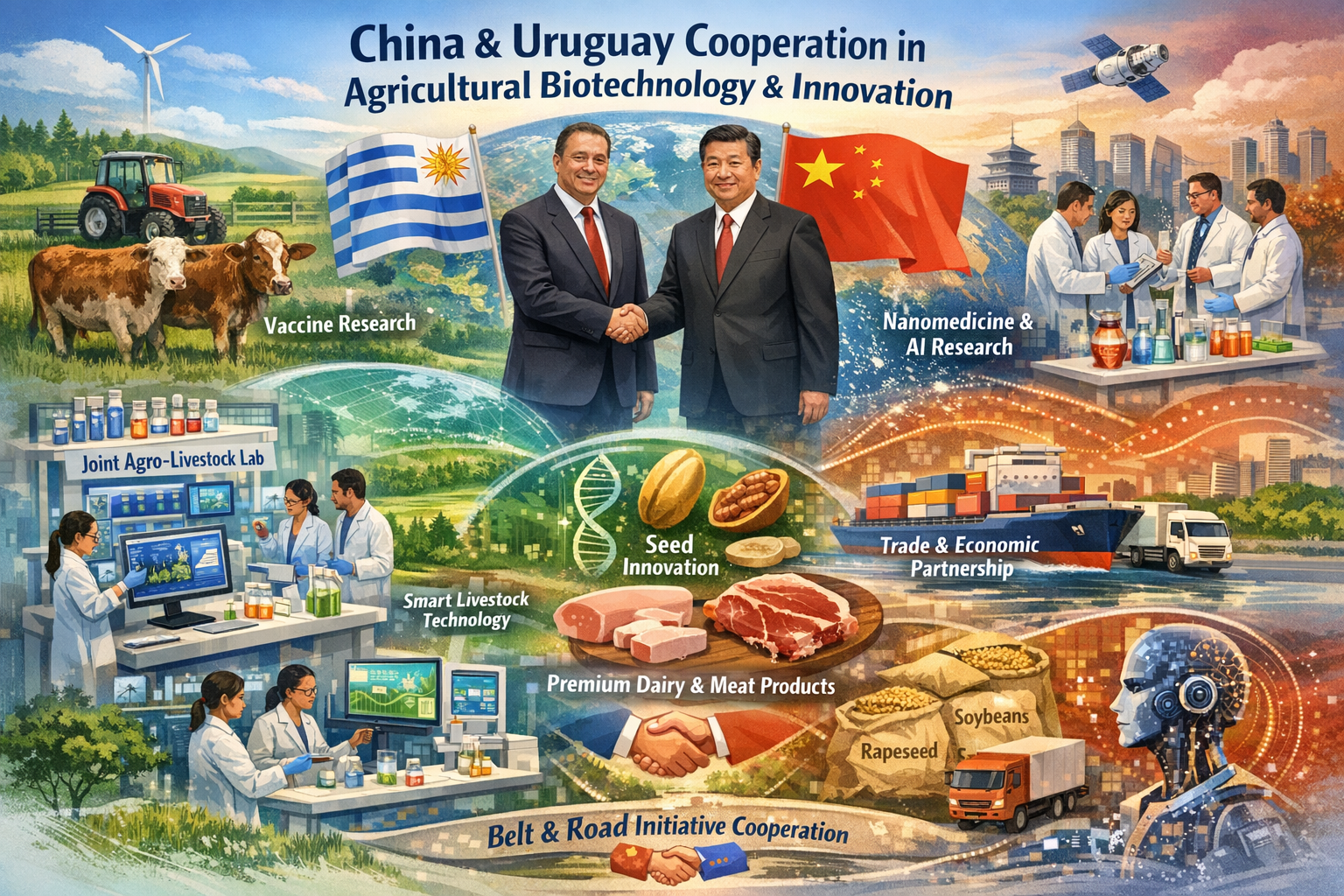
A New Chapter in Bilateral Scientific Collaboration
The recent state visit of Uruguay’s President Yamandú Orsi to China marked a significant milestone in bilateral relations, particularly in agricultural biotechnology, scientific research, and innovation. As global demand for food security, sustainable agriculture, and advanced biotech solutions continues to rise, partnerships between technologically advanced nations and resource-rich agricultural producers are becoming increasingly strategic. In this context, China and Uruguay cooperate to accelerate innovation across agriculture, livestock, biotechnology, and nanomedicine—areas that could reshape productivity, competitiveness, and scientific capacity in both countries.
Why Agricultural Biotechnology Matters for China and Uruguay
China is currently the world’s largest consumer of livestock and forage products, with rising demand driven by population growth, dietary changes, and urbanization. To ensure food security, China is diversifying its import sources and strengthening international agricultural partnerships. Uruguay, meanwhile, stands out as a global agricultural producer with:
- Extensive pastureland
- A strong cattle and dairy industry
- High-quality genetic livestock resources
- A reputation for traceability and food safety
These strengths make Uruguay a strong partner for China’s efforts to modernize its agriculture.
“Uruguay is a country with a great wealth of natural resources that must be leveraged with advanced technology,” said Lucas Borchardt, CEO of Reevolution.
Establishing a Joint Agro-Livestock Laboratory
One of the most notable outcomes of the visit was the signing of an agreement to create a joint agro-livestock research laboratory between:
- Qingdao Agricultural University
- Vland Biotech (China)
- Uruguay’s National Institute of Agricultural Research (INIA)
- Reevolution (Uruguay)
The laboratory aims to turn traditional livestock systems into modern, data-driven, and high-value production models.
Key Research Areas
The joint laboratory will prioritize:
- Grass seed innovation to improve pasture productivity
- Smart livestock technologies for monitoring animal health and productivity
- Precision disease prevention and control systems
- Development of premium dairy and meat products derived from pasture-based systems
- Introduction of high-quality plant and animal genetic resources
This project moves beyond simple academic exchange and focuses on combining research, production, and real-world use.
“Our institution has global leadership in improving pasture quality and efficiency,” explained Professor Sun Juan from Qingdao Agricultural University.
Technology Transfer and Smart Livestock Production
A critical component of the collaboration is technology transfer. China plans to provide Uruguay with advanced solutions in:
- Healthy breeding technologies
- Smart herd management systems
- Deep processing of pasture-based livestock products
- Digital monitoring tools and AI-driven livestock analytics
Uruguay’s agricultural sector has shown a clear need for new ideas, especially in processing and creating higher-value products. By working with China, Uruguay aims to go beyond just exporting raw goods and develop more advanced, technology-driven agribusiness.
Potential Impact on Uruguay’s Agricultural Sector
Experts anticipate that the partnership could transform Uruguay’s livestock industry by enabling:
- Higher productivity per hectare
- Improved genetic breeding programs
- Enhanced traceability and quality control
- New premium export categories for Asian markets
- Increased integration into global agricultural innovation networks
Borchardt said that working together on genomic analysis, pasture improvements, and seed development can benefit both countries and speed up scientific progress.
Expanding Collaboration in Vaccine Production
The Uruguayan delegation also visited Vland Biotech’s research laboratories and vaccine production facilities, highlighting interest in scaling vaccine manufacturing.
Agustín Correa Bove, CEO of Scaffold Biotech, noted:
“We are expanding vaccine production, and finding a partner like Vland is essential to accelerate this process.”
This partnership could help Uruguay’s pharmaceutical and veterinary biotech industries grow and improve disease prevention for both livestock and public health.
Joint Nanobiotechnology and AI Research Platforms
Beyond agriculture, the partnership extends into cutting-edge biomedical and nanotechnology research. The University of Qingdao and the University of the Republic of Uruguay signed a memorandum to establish a joint pharmaceutical bionanotechnology laboratory.
Planned Research Platforms Include:
- Biological nanomaterial design and intelligent synthesis
- Biomedical big data and AI computing platforms
- Functionalized nanomedicine preparation and precision delivery systems
- Nanomedicine product development and commercialization platforms
The goal is to build an international center that draws top scientists and speeds up the sharing of new technology. By working together in nanomedicine, China and Uruguay cooperate and hope to lead in smart biomedical innovation.
Artificial Intelligence in Oral Pathology
Another advanced collaboration involves the Faculties of Dentistry at both universities, which agreed to establish a joint laboratory focused on AI-driven oral pathology. The initiative aims to:
- Develop AI models for digital histopathology
- Create interoperable and standardized clinical databases
- Improve diagnostic accuracy through machine learning
This partnership shows how bilateral cooperation is expanding beyond agriculture into advanced healthcare technologies.
From Academic Exchange to Integrated Innovation Networks
Historically, collaboration between China and Uruguay began with academic exchanges and joint research projects. Today, it is evolving into a multidimensional innovation ecosystem involving:
- Universities
- Private biotechnology companies
- Government research institutions
- Industrial partners
This combined approach helps both countries bring scientific discoveries to market more quickly and build stronger innovation skills. China and Uruguay cooperate and are also working with other countries in the Belt and Road Initiative, expanding their research worldwide.
Economic and Trade Relations: A Growing Partnership
The scientific partnership is supported by a rapidly expanding economic relationship. Since establishing a comprehensive strategic partnership in 2023, bilateral trade has grown steadily.
Key Trade Highlights
China has been Uruguay’s largest trading partner for several consecutive years. In 2025, bilateral trade reached $7.19 billion, up more than 9% year over year.
Uruguay exports:
- Beef
- Dairy products
- Wine
- Soybean meal
- Rapeseed meal
China exports:
- Automobiles
- Household appliances
- Consumer goods
These trade exchanges give Chinese consumers access to high-quality farm products and help improve living standards in Uruguay by making manufactured goods more affordable.
Strategic Implications for Global Agriculture
The collaboration reflects broader global trends:
- Rising demand for sustainable agriculture
- Increasing role of AI and biotechnology in food production
- Growing South–South and South–North scientific partnerships
- Integration of digital technologies in livestock and crop managemen
By combining China’s technological expertise with Uruguay’s agricultural resources, both countries are positioning themselves as leaders in next-generation agri-biotech innovation.
Opportunities for Investors and Industry
The expanding partnership opens new opportunities for:
- Agribusiness companies
- Biotechnology firms
- Venture capital investors
- Universities and research institutions
- Startups in AI, genomics, and agricultural technology
Joint labs and innovation platforms open doors for new business, partnerships, and technology sharing. The way China and Uruguay cooperate and are working together could bring global investment into agricultural tech centers in both countries.
Looking Ahead: A Model for Future Bilateral Innovation
As China and Uruguay commemorate 38 years of diplomatic relations in 2026, their partnership is shifting from traditional trade toward a knowledge-based, innovation-driven alliance. Key future priorities include:
- Expanding joint research programs
- Scaling industrial applications of biotech innovations
- Training and exchanging scientific talent
- Strengthening digital infrastructure for smart agriculture
- Developing joint standards and regulatory frameworks
By combining science, trade, and strategic diplomacy, this partnership serves as a model for other countries that want to modernize their agriculture and biotechnology sectors.
Conclusion: Building a High-Tech Agricultural Future
The recent agreements are more than just symbolic—they mark a real shift toward working together on technology and the economy. The partnership now covers smart livestock systems, advanced vaccines, AI-based diagnostics, and nanomedicine. By joining natural resources with new technology, China and Uruguay are setting an example for sustainable farming, scientific achievement, and global competitiveness. Their teamwork demonstrates how international partnerships can accelerate progress and economic growth in today’s world.