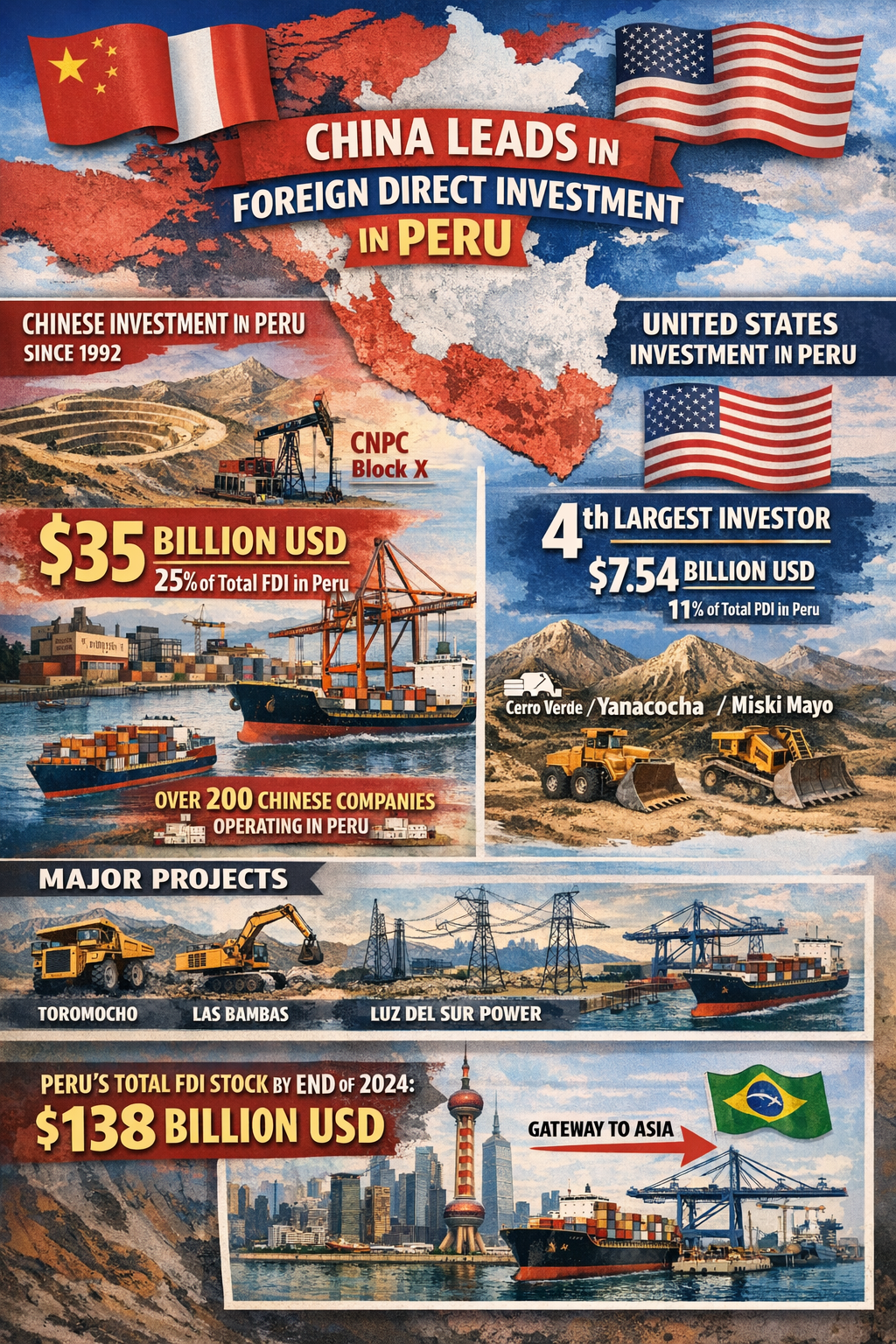
Recent specialized calculations show that Peru has received around US$35 billion dollars in Chinese investment since 1992. These calculations come from a variety of sources and place China as the leading investor in Peru in terms of Foreign Direct Investment (FDI).
United Nations research showed that Peru had a total FDI stock of US$138 billion dollars by the end of 2024. In contrast, American Chamber of Commerce of Peru (AmCham Peru) showed that American investment reached US$7.544 billion dollars as of 2021.
Taking both studies into consideration places the United States in fourth place for Peru’s leading foreign investors.
Projects like the Port of Chancay have been what specialists say has grabbed worldwide attention about China’s position in Peru. The port will be operated and majorly owned by Cosco Shipping Ports Chancay Perú S.A., which is partially owned by Chinese State Enterprise Cosco Shipping Ports Limited (60%) and Peruvian mining company Volcan Compañía Minera (40%).
The discussion around the project’s expectations and feasibility has made it a hot topic when considering the future of foreign direct investment in Peru regarding big infrastructure projects.
Some analysts claim that this port will be considered the primary entrance to South America’s west coast. This could mean new opportunities for Brazil; a country interested in decreasing the time and resources it takes to ship its production to Asia. This discussion points to the Chinese port of Shanghai as Asia’s principal doorway.
This Chinese investment growth is taking place during an ongoing Chinese worldwide expansion phase that can be looked at as anti-thesis to the United States current policies towards Asia. During the second half of Donald Trump’s presidency, the United States took an isolationist stance when it came to Asia, showing interest in stopping Asia’s growth in this region of the world.
At least when looking at Peru, data shows the US falling behind. After analyzing previous figures, China represents close to 25% of all foreign direct investment in Peru.
How Did We Get Here?
Carlos Aquino, economist and director of the Center for Asian Studies at the Universidad Nacional Mayor de San Marcos (UNMSM), expressed how China was able to establish such a strong corporate presence in Peru starting from 1992, when Shougang purchased Hierro Perú.
“That was significant because at that time China had just opened its doors to the world back in 1978–1979. Hierro Perú was the first Chinese investment outside of Asia,” Aquino said.
This purchase allowed Shougang to become the number one iron producer in Peru with almost 99% of all national production.
Just two years later, China would make another large entrance when China National Petroleum Corporation, also known as CNPC, was granted concessions to several oil blocks in northern Peru. One of these blocks happened to be Block X.
Chinese investment wouldn’t start to pick up pace until after they joined the World Trade Organization (WTO) in 2001. This allowed China to exponentially grow its exports consisting mainly of manufactured goods. With this came an increased demand for raw materials, which China then went out and sourced from all over the world. The commodities boom starting around 2002-2003, when the price of copper and other metals started to soar, also played a key role in China’s weight in foreign direct investment in Peru.
“The largest purchase related to copper was made by Aluminum Corporation of China, also known as Chinalco, which acquired the Toromocho project located in the Junín region in 2005. Another large investment would be Las Bambas in Apurímac,” said Aquino. Las Bambas was bought from Glencore–Xstrata consortium.
“Between Toromocho and Las Bambas China represents close to 20% of Peru’s national copper production. Total investments between the two mine projects are close to US$15 billion dollars,” Aquino added.
Aquino went on to explain that until the early years of this century, China was mostly focused on acquiring and investing in Peru’s natural resources. As years went by, China started investing in infrastructure. The representative project Aquino uses is from the year 2020, when China Yangtze Power International (a subsidiary of China Three Gorges Corporation) acquired Luz del Sur.
“After that, in 2024, we saw China Southern Power Grid International, or CSGI, acquire Enel Distribution Perú for approximately US$2.9 billion dollars. The company changed names to Pluz Energía Perú after selling 83.15% of its shares,” Aquino explained.
State-Owned Enterprises
Aquino stressed that the majority of these Chinese companies, whether they invest in mining or infrastructure, are state-owned. Cosco Shipping, owner of the majority of the Port of Chancay, operates under that category as well. Aquino finished off by saying that the Chinese bank’s with operations in Peru (ICBC Ltd. and Bank of China Limited) also fall under that category.
When asked about the total amount of money that China has invested in Peru, Aquino said that it’s hard to calculate. “Las Bambas alone cost the Chinese-led consortium by MMG (Mineral Mines Group) US$6 billion. And then they invested close to US$4 billion dollars more,” Aquino stated.
Aquino finished off by saying that about three or four years ago, the Chinese ambassador to Peru stated that Chinese companies had invested over US$30 billion dollars in Peru. He also stated that there are over 200 Chinese companies with operations in Peru.
A research center based in the United States reported that from 2005 to January – June 2025, total Chinese investment in Peru amounted to US$31.8 billion dollars. Including construction.
“That tells me that maybe from 1992 to 2005, Chinese companies invested around US$3 billion dollars. So, if we reached US$31 billion by the middle of 2025. By now, we are close to US$35 billion dollars invested,” the economist concluded.
Aquino later went on to say that the United Nations, which publishes a yearly report on global foreign investment, showed that by the end of 2024, Peru had reached US$138 billion dollars of foreign investment. With that in mind, US$35 billion is around 25% or one-fourth of the total. “That makes China the country with the most investment in Peru,” Aquino concluded.
Where does the US fit in with all this?
The Economic Department of AmCham Peru recently sent a press release regarding Foreign Direct Investment in Peru. Citing data provided by ProInversión, the United States represents the fourth-largest foreign investor in Peru, representing approximately 11% of the total stock of foreign direct investment in Peru by the end of 2025.
According to the United States Bureau of Economic Analysis (BEA), the US is the only country with investments in all 15 sectors ProInversión maps. “The majority of this investment is in mining, representing 57% of total US investment in Peru.”
AmCham Peru went on to say that the US has investments in the financial sector, manufacturing (food production, chemical goods, electronic components), commerce, information technology, and professional services.
“Mining-wise, there are only three companies responsible for US investment. Cerro Verde (Freeport McMoRan), Yanacocha (Newmont), and Miski Mayo 75% due to a US company.”
When looking at just the inflows of investment, the United States was one of few countries that increased its share in 2024. According to ProInversión yearbook of statistics, US investment increased by US$17 million dollars in 2024. From January – November of 2025 Cerro Verde increased their investments by 8% totaling US$342 million dollars. Miski Mayo increased their investment by 75% to US$24 million dollars.
Lastly, AmCham Peru showed that as of 2021 Peru received US$7.544 billion dollars of direct investment from the United States. A 4% increase compared to last year, 2020. Although 2014 was the year with the highest amount of foreign investment in Peru at US$8.097 billion dollars. Peru has seen an exponential growth in investment since 2016.