
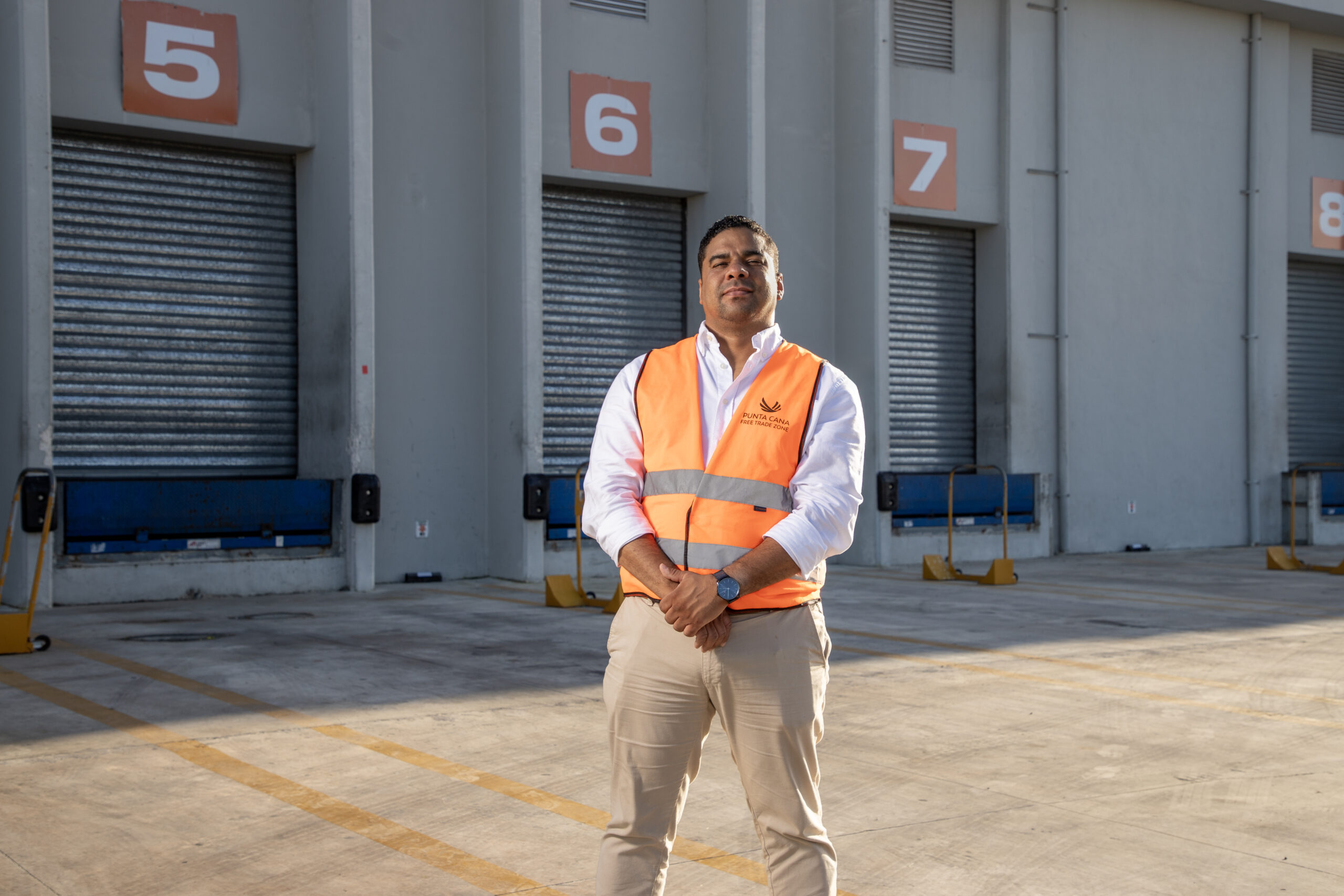
Ebell de Castro
General Manager
Punta Cana Free Trade Zone
Punta Cana, Dominican Republic
edecastro@puntacanafreezone.com
LATAM FDI: We have Abel de Castro with us today. Abel, how are you?
Ebel de Castro: Hello, Steven, I’m very fine, thank you. Very pleased and very happy to be here with you today.
LATAM FDI: Well, I’m glad you are with me as well. I always like to ask the people that I interview to start by telling us a little bit about their background and about their organization.
Ebell de Castro: Thank you, Steven. First of all, I am passionate about free zones and foreign investment. I have been working in the free zones of the Dominican Republic for over 20 years, since I was 18. So, my career started at the National Free Zones Council, which, as you may know, is the main government body in the Dominican Republic responsible for promoting and regulating free zones. There, I had the opportunity to work with several multinational corporations on interesting investment projects, including a greenfield investment in the DR. From there, I worked as a general manager at Nigua Free Zone, a private free zone park in the Dominican Republic. There, I had the chance to be involved in an expansion project aimed at increasing the park’s size by 3. And after spending 6 years, 5 years, almost 6 years as general manager of the Nigua Free Zone, I received an offer to serve as general manager of the Punta Cana Free Trade Zone, a new and unique free trade zone in the Dominican Republic.
It is an initiative of Grupo Punta Cana, which, as you may have heard, is one of the main economic groups in the Dominican Republic, a corporation with more than 22 companies that were initially well known worldwide for developing Punta Cana as a global tourist destination. So now, you know, taking into account all these experiences, all this development, and all these externalities that have emerged in Punta Cana, the group established the Punta Cana Free Trade Zone, which is the park where I am pleased to work now as general manager.
LATAM FDI: Well, thank you for that background information. I’ve got a few questions to ask you today. And the first one is: what makes the Dominican Republic an attractive destination for international companies looking to expand?
Ebel de Castro: Well, I think that the Dominican Republic has developed remarkable competitive advantages over the years. But I think that the main, uh, the main— I would say the main incentive, the main positioning that the Dominican Republic has to show to the world for free zones development and for attracting foreign investments into the free zones. It is the economic incentive packages that I believe are the most competitive in the region, you know. First, this incentive scheme exempts companies from 100% of all national and local taxes for 15 years, and the exemption can be renewed as long as the companies contribute to job creation, foreign currency generation, and technology transfer. These incentives would remain in place. And together with this, I think that it is important to mention the economic and political stability that the Dominican Republic has, you know, enjoyed. For the last 50 or 60 years, we have been living in a democracy. We have had elections for 60 years, with new presidents every 4 years. We have a government that is an ally of the private sector. It is a pro-business government.
So, I think this has been key, Steven, for positioning the country as a solid option, a solid alternative for foreign investors.
LATAM FDI: You touched upon this a little bit, but maybe we could go into a bit more detail. For a company that is considering investing in the DR, what are the key factors you think they should evaluate before making a decision whether or not to start operations there?
Ebel de Castro: Well, I think one of the main things that is very appealing to investors, manufacturers, and logistics operators who will work in the global marketplace is logistics and connectivity. The DR has a network of 9 international airports and 11 ports. You know, in different years, according to the Global Competitiveness Report, the Dominican Republic has been ranked as the Latin American country with the best-quality transport infrastructure. So, in addition to this, we should take into account that we have great connectivity. For example, just to mention one case: at Punta Cana International Airport, we handle approximately 900 flights per week and serve 85 destinations directly from there. So, you can fly from Punta Cana, or you can send cargo from Punta Cana, from any other place through Punta Cana, and you will have the cargo in the final destination in less than one day. We offer direct flights across Europe, including Poland and Finland, and we fly to 17 Canadian cities daily.
So, you know, these are advantages that not a lot of countries have. Other very important elements are the strong network of industrial parks we have in the DR. We have almost 100 industrial free zone parks, located all over the country, especially in areas with high-quality labor and airports and international ports, as I mentioned earlier. And most of all, we have a very cost-competitive economy. We have very attractive labor costs, which are currently, on average, competitive with those of Asian countries like China. So, you know, the idea that we are more expensive than Asian countries is not necessarily true. I think that it is another advantage that a new investor should take into account.
Well, I think that currently we’re seeing something very, very interesting. For example, you know that in the past, maybe 90% of the workers in the free zones were basic operators. Now let’s say 60% of all the workers that we have are operators and 40% are technicians. This means we are increasing the value of the products we manufacture and export. So that is, I think, great news because, you remember, Steven, in the past most of the products that we used to manufacture were apparel and very basic assemblies, right? Right now, we are competing in the manufacturing of medical devices and high-value electronic components, and, you know, this definitely says a lot about how we have learned, how we have gained expertise, and especially that we are competing in these segments with advanced countries. But now we are seeing the beginning of new industries like aviation, like aerospace, which is what we are trying to develop at the Punta Cana Free Trade Zone.
LATAM FDI: For those who may not be familiar with it, your free zone, the Punta Cana Free Trade Zone, how does it fit in with the country’s economy? How does it fit in with the logistics system? Can you fill me in on that?
Ebell de Castro: Yes, well, first of all, Steven, the Punta Cana Free Trade Zone is the first industrial and logistics park located within an international airport in this region. You have other business parks within airports and around nearby airports, but this is located inside the Punta Cana International Airport. This means a lot for logistics. Just, just think that manufacturers that establish themselves in the Punta Cana Free Trade Zone, logistic operators that establish operations in the Punta Cana Free Trade Zone, can move their goods from their warehouses to the cargo terminal in less than 5 minutes. The air cargo terminal, which we call the Air Cargo Hub, is located within the free zone park. All products that the Dominican Republic exports through the Punta Cana International Airport, or that are important to the Punta Cana International Airport, or cargo that goes in transit through the Punta Cana Airport, you know, has to go to the free zone first. But remember, the free zone is inside the airport. We think this aligns well with the Dominican Republic’s goal of becoming a regional logistics hub.
But also, companies that move their goods by air, as I mentioned earlier, have the great advantage of an airport in their backyard.
Ebell de Castro: Well, you mentioned just now the aviation component. You talked about MRO maintenance of aircraft. Why is this relevant to the Dominican Republic region in general?
Ebel de Castro: Well, you know, the MRO, the maintenance of aircraft, is a new industry in the Dominican Republic. It is important to mention that there are several different subzones within the Punta Cana Free Trade Zone. One of them is the Logistics Zone, the Logistics Center Zone. Another zone is the Manufacturing Center, where we will manufacture products that will be transported primarily by air, such as medicines, pharmaceuticals, jewelry, and high-value electronics. There is another, which is the MRO, the maintenance, repair, and overhaul. So the idea is to have, you know, in an area of the park with access to the airport, a hangar currently operated by FL Technics, one of the world’s largest providers of maintenance services. This company will create approximately 1,000 specialized jobs, Steven. But think about the demand that this company will have for aerospace components and engineering services. This creates a new labor market in the Dominican Republic for people who are prepared and capable of working in the aviation industry. In both manufacturing and services, because this MRO has, you know, also some areas where they also manufacture a few of the components that they use for their services.
LATAM FDI: What’s the long-term vision for your Punta Cana Free Zone, and what types of companies are you looking to attract to it? You touched on this question a bit, but could you be more detailed?
Ebell de Castro: Of course. Well, first, our target— what are we attracting? First, companies related to the aerospace and aviation industries, and the manufacturing industries in general. This is maintenance, repair, and overhaul (MRO). All aviation activities related to maintenance and manufacturing. Services are also part of the target that we are attracting. The second one, the second very important target is value-added logistics services. As I mentioned earlier, we have a logistics center within the park, and there we are promoting the establishment of distribution centers. And you can think about, for example, companies that work in the fast fashion industry. We are, for example, promoting the establishment of companies that will import garments and luxury goods into these warehouses. Here, they will provide added-value logistics services such as packaging, labeling, and similar activities. And from there, they will distribute these products to all their stores and distribution centers throughout the whole region. And the third target that we have is the manufacturers of goods that are mainly transported by air. This includes aviation components, jewelry, pharmaceutical goods, and many others.
So, what is our vision right now? While we are training workers in the aviation industry who are gaining skills for, if you know, for, for, for their— and in the airspace industry in general, we believe that in the long term, let’s say in 15 years to 20 years, we could be manufacturing aircraft in the Dominican Republic in the Punta Cana Free Trade Zone. That is the vision, Steven: assembling an aerospace cluster within the Punta Cana Free Trade Zone that would be the first of its kind in the Caribbean.
LATAM FDI: That sounds very interesting. One thing that’s consistent about these podcasts is that listeners often want to ask further questions to the people who participate in them. So, I’m wondering: if someone who hears this wants to get in touch with you, how would they go about it?
Ebell de Castro: Well, I would be more than happy, you know, to explain, to present our value proposition to any of our— any of the people that are part of the audience. Anyone can email me at the personal email listed at the top of the transcript page. Additionally, they can visit our website and fill out the contact form. And our website is www.puntacanafreezone.com.
LATAM FDI: What I’ll do as well is, at the top of the transcript of our discussion, I’ll put your LinkedIn profile, if that’s okay, your email, of course, your email, and the links that you just mentioned.
Ebell de Castro: Perfect.
LATAM FDI: Well, I want to thank you for being with me today. It’s very interesting what’s going on in the Dominican Republic, and I wish you a lot of success.
Ebell de Castro: Thank you very much, Steven. I really appreciate the opportunity of talking with you and your audience.
LATAM FDI: Have a great day.
Ebell de Castro: You too, Steven. Goodbye.
Customs benefits:
Companies located in free zones in Colombia “are exempt from paying customs taxes (tariff and VAT) for the importation of goods that they introduce into the free zones. However, when a good produced in a Colombian free zone is sold in the national territory, such a transaction is considered an import. Therefore, at that moment, companies must pay these taxes and comply with the requirements of all imports.
Furthermore, although merchandise sold from Colombia to a free trade zone must carry out the export process, it is possible to enter national goods into a free trade zone so that they can be processed or transformed and returned to Colombia. In these cases, customs procedures are not required, only authorization of the user, operator, or administrator of the Free Zone.
In turn, damaged or poorly maintained merchandise that is within a free zone in Colombia does not have to be nationalized. Such items can be removed or destroyed within the free zone without paying taxes.
Foreign trade benefits:
In this realm, companies in free zones in Colombia have access to seven specific benefits. These are:
- Goods from abroad brought into the free zone do not require an import declaration. The goods are only required to appear on the transport document as consigned to a free zone user where the items brought from abroad will arrive.
- Raw materials, capital goods, inputs, and any merchandise entering a free zone are not considered imports. Therefore, companies in free zones in Colombia do not have to pay duties or VAT while they are inside the designated area. However, if they leave Colombian national territory, they must be imported. Once this is done, an import declaration must be presented, the tariff and VAT must be paid, and the other requirements demanded by customs and foreign trade legislation must be met.
- Exiting merchandise to another country from a free zone in Colombia does not require submitting an export declaration because the merchandise transit form acts as this document. Departures to another country only need authorization from the free zone operator.
- Companies located in free trade zones, domestic and foreign investors, can temporarily enter raw materials and intermediate goods into Colombia for partial processing without this implying import costs or prior customs authorizations.
- Merchandise entering a Free Zone may remain within the Free Zone indefinitely. This is a benefit since companies can carry out the nationalization or import when they have a specific need for the goods.
- There are no restrictions on selling goods or services produced in a free zone in Colombia, in third countries, or in the national territory.
- The companies installed in a Free Zone can have offices and staff outside the Free Zone in the national territory.