
Latin America in a “Low-growth Trap”
Latin America is headed into 2026 without a clear path to robust growth. The Economic Commission for Latin America and the Caribbean (ECLAC) projects a tepid 2.3% regional expansion for 2026, confirming four straight years of growth around 2%. This outlook is shared by the World Bank and the International Monetary Fund (IMF), with the latter’s latest projections offering a 2.1% estimate for Latin America in 2026 with very slight differences among its country forecasts. This challenging environment sets the stage for a fragmented picture of Latin American economic growth in 2026, where growth will be increasingly concentrated in a handful of strongly performing economies.
Divided Among Winners and Laggards
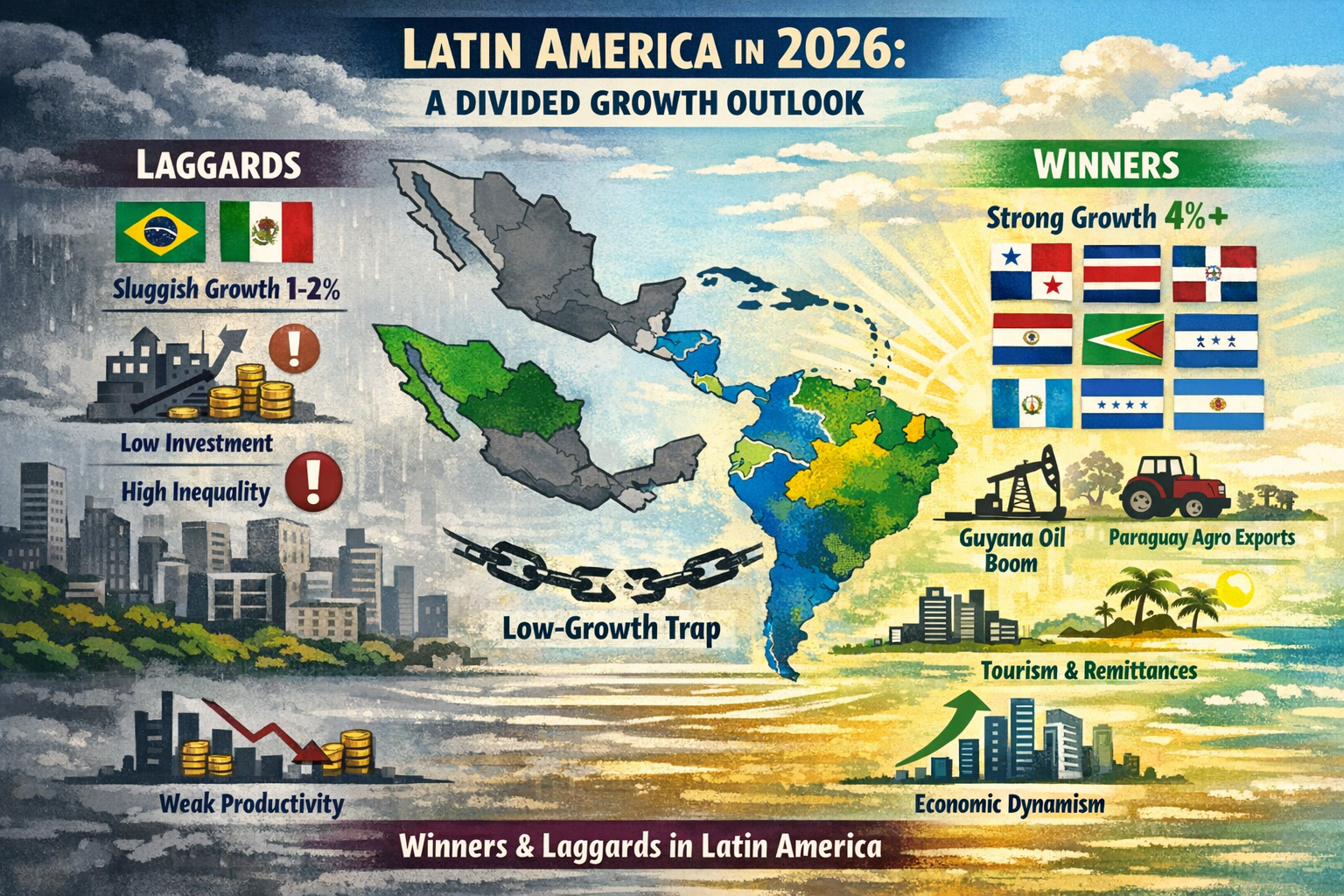
The simple average masks a growing chasm between laggards and winners. Large economies Brazil and Mexico will likely continue to grow well below their historical rates, but will lead relative expansion among Latin American countries at close to 4%. At the other end, a cluster of medium-sized and smaller economies, many of them in Central America, will outperform their larger neighbors, with Panama, Costa Rica, the Dominican Republic, Paraguay, Guatemala and Honduras near or above 4% growth, alongside the atypical cases of Guyana (a one-off driven by a temporary bonanza in its nascent oil sector) and Argentina (a cyclical recovery). Together, these countries will contribute disproportionately to regional expansion and power a turning point in Latin American economic growth in 2026.
Structural Weaknesses to the Fore
ECLAC warns that, if current projections hold, Latin America will have registered just 1.6% average annual growth between 2017 and 2026. In a recent interview, the body’s executive secretary José Manuel Salazar-Xirinachs also drew attention to the expected weakening of private consumption in 2026 as external demand softens and job creation and business investment lose steam after several years of extraordinary energy and commodity prices. Meanwhile, the World Bank’s regional GDP growth forecast for 2026-2027 is a modest 2.5%, the weakest among the Bank’s emerging regions, while the IMF also projects a deceleration to 2.3% growth in 2026 after a 2.4% increase in 2025. As ECLAC’s Salazar-Xirinachs has noted, “structural factors are showing their limitations, and the region is sinking into a low-growth path characterized by weak investment, low productivity and high inequality”. This will set a decidedly lackluster tone for Latin American economic growth in 2026 overall.
Guyana and Paraguay to Shine
Against this general backdrop, several countries stand out on the upside. Guyana is the obvious case. ECLAC projects an eye-popping GDP increase of 24% in 2026 for Guyana, though this is largely the result of a non-recurring fast-tracking of oil production which will taper off over time, as corroborated by IMF forecasts pointing to average growth of around 14% a year over the medium term, of which non-oil would represent the lion’s share. Guyana is a special case of a very small and oil-dependent economy that is set to benefit from massive but one-off investment in a single export product with minimal direct impact on regional and Latin American economic growth in 2026. A different story is being written in Paraguay, where ECLAC sees growth of around 4% in 2026, with some forecasts nudging that up to 4.5%. The country is experiencing a gradual transformation of its productive matrix, based on a competitive agro-industrial foundation, light manufacturing, logistics, and low-cost energy exports. Fiscal and monetary discipline add predictability and macroeconomic credibility to the mix. Should it sustain this performance, Paraguay is destined to be South America’s fastest-growing economy outside of Guyana and one of the more interesting sources of Latin American economic growth in 2026.
Central America and the Caribbean Gain Relative Ground
Elsewhere, 2026 will see Central America and the Caribbean, with the obvious exception of Guyana, outpacing the regional average. Panama is expected to grow at around 4-4.2% as Canal activity, logistics, and financial services help it weather the effects of the winding down of the giant Cobre Panamá copper mine. The Dominican Republic’s growth in 2026 will be about 4.3%, with ECLAC already pointing to a record year in 2025, mainly in the tourism sector, which will support domestic demand. Other factors such as export-oriented free zones and an investment-friendly fiscal and monetary policy will also contribute to a growth trajectory that will converge again toward its long-term average of about 5%. Guatemala and Honduras should also see growth rates near 4% as their economies continue to benefit from strong remittances and resilient domestic consumption. Costa Rica is set to grow around 3.3-3.6% in 2025-2026, clearly above the regional average and also well above its long-term trend. This acceleration is expected to be concentrated on high-tech exports of knowledge-intensive services, as well as free trade zone-oriented manufacturing and a tourism sector that has fully recovered after the pandemic shock.
Argentina’s Risky Recovery
Arguably, the most interesting case is Argentina. The country is projected to register relatively high growth of 4-4.5% in 2025-2026, but this will mainly reflect a cyclical bounce-back from low base effects following two years of recession and output contraction. Argentina has been singled out by the World Bank as one of the key engines of a regional upturn in 2026. However, the IMF has significantly downgraded its own projections, and the Fund’s analysis still flags elevated, albeit falling, inflation and major political and social uncertainty as key downside risks. In terms of Latin American economic growth in 2026, Argentina remains a very high-risk, high-reward bet for investors.
Brazil and Mexico Set to Drag the Region Down
Brazil and Mexico, on the other hand, look set to underperform. ECLAC projects just about 2% growth for Brazil and a mere 1.3% for Mexico in 2026. Mexico’s subpar performance will partly reflect the impact of new U.S. trade barriers that could further reduce its main export engine and slow a long-delayed modernization of its infrastructure and energy generation and transmission networks. In the case of Brazil, persistently high real interest rates, a restrictive fiscal space, and weaker demand for its commodity exports are likely to remain significant headwinds to higher and more dynamic growth. In short, the epicenter of Latin American economic growth in 2026 will migrate from the region’s traditional engines to smaller and mid-sized economies with more robust macroeconomic fundamentals.
Conclusion: Consolidating the Winners and Laggards Divide
In sum, while the outlook for Latin American economic growth in 2026 remains challenging, it is also set to become less homogeneous. Put simply, 2026 is unlikely to bring a broad-based growth boom to Latin America, but it will see the contours of such a boom become much clearer. Growth will be increasingly concentrated in those economies that have a combination of factors on their side, including macroeconomic stability, sectoral specialization, and institutional credibility, instead of just large economic size. On the one hand, this will call on policymakers to deepen reforms aimed at boosting productivity, investment and competitiveness if they wish to convert near-term momentum into a virtuous circle of sustainable expansion. On the other hand, investors will find that Latin American economic growth in 2026 is likely to become a more selective, idiosyncratic and opportunity-rich landscape, with a greater role for economies that have found or created resilient niches and offer predictable and reliable business climates. In that sense, 2026 may be less of a year of rapid growth acceleration than a watershed for how and where growth is being generated across Latin America.