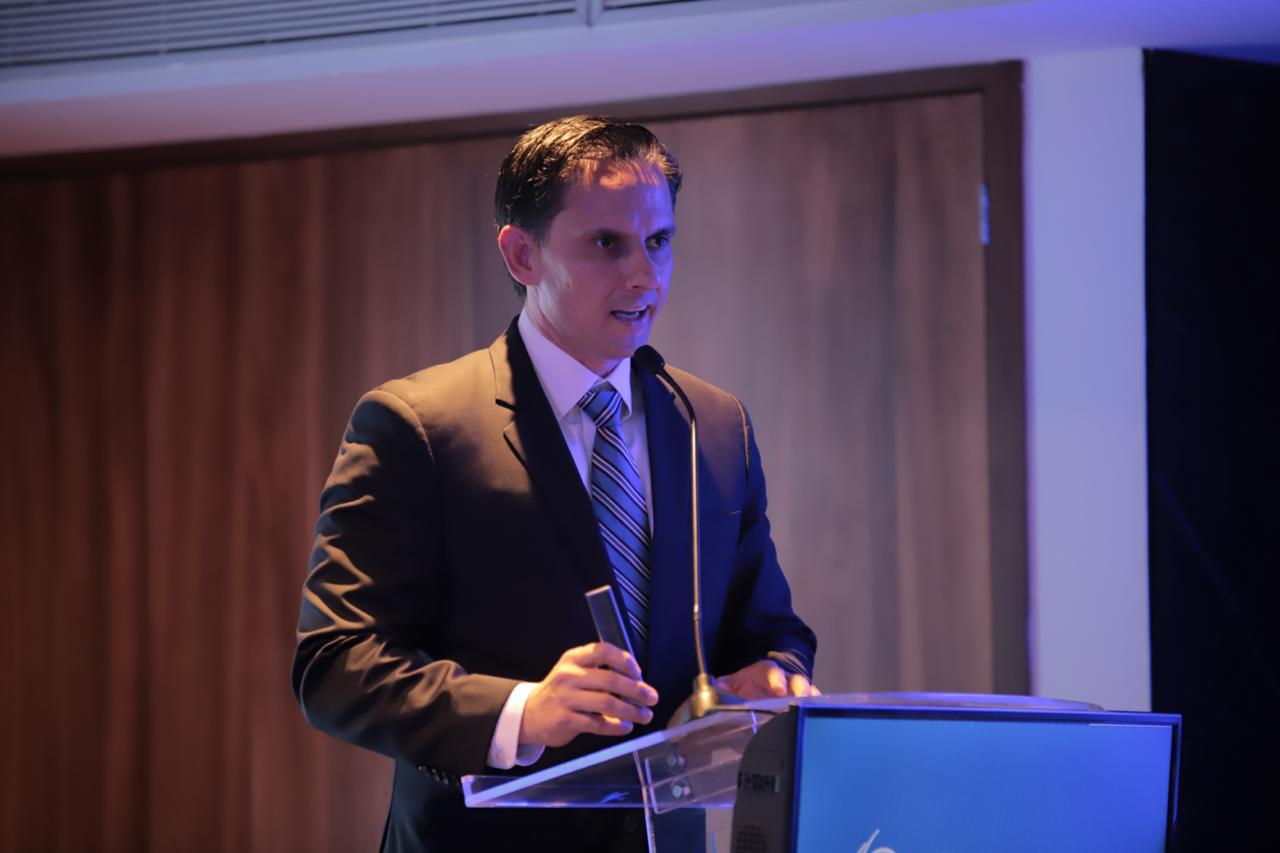
Juan Carlos Zapata
Executive Director
FUNDESA
jczapata@fundesa.org.gt
LATAM FDI: Hello, today we have with us, Juan Carlos Zapata. Juan Carlos is the executive director of FUNDESA, a Guatemalan organization. Juan Carlos, nice to see you. How are you?
Juan Carlos Zapata: Thank you, Steven. Very nice to be here, and thank you for the opportunity.
LATAM FDI: Could you tell us a little bit about yourself and your organization?
Juan Carlos Zapata: Well, I’m the executive director of FUNDESA. FUNDESA is the Foundation for the Development of Guatemala. We’re a private nonprofit think tank. We are comprised of businesspeople in their personal capacity, and we work on competitiveness issues to increase productivity in Guatemala, enhance the country’s ability to attract more foreign direct investment, and generate more jobs and employment opportunities. And to do so, we work with various groups from both the public and private sectors to advocate for increased investment in infrastructure, human capital, and the rule of law.
LATAM FDI: Well, now that you’ve explained what role the FUNDESA plays in Guatemala’s economic development, tell us a little bit about the macroeconomic situation in Guatemala today.
Juan Carlos Zapata: Well, Guatemala is one of the most stable countries when you talk about the macroeconomic stability of countries in Latin America. When you look at the exchange rate of the quetzal, our currency, it’s been around 780 quetzales per dollar. When you see the different credit rating agencies, Fitch, Moody’s, and Standard & Poor’s, we are one notch below investment grade. It has improved over the past 20 years. Macroeconomic stability in Guatemala grew by 4.3% last year. There has been an effort from both the public and private sectors to attract more foreign direct investment and generate more investment opportunities in Guatemala. So, we think that our macroeconomic stability is one of the key assets of the country in order just to— when you talk about how to attract more foreign direct investment in Guatemala.
LATAM FDI: You’ve mentioned before that FUNDESA is involved with an effort called Guatemala Moving Forward. Could you tell us what that is?
Juan Carlos Zapata: Yes, after the COVID pandemic, we began to understand the shifts in different purchases and how Guatemala could apply them to increase nearshoring and take advantage of the nearshoring opportunities we saw worldwide. So, we subcontracted with the international consulting firm McKinsey to help us understand where we could improve across our various challenges and how to better approach foreign direct investment. Even though foreign direct investment has been growing, it’s still below 2% of GDP. When you look at other countries in Latin America, you see that Costa Rica, for example, they attract almost 5% of its GDP in foreign direct investment. The Dominican Republic is close to 6%. We understood that we still have some bottlenecks in order to attract more foreign direct investment. Through the initiative Guatemala Moving Forward, we began forming working groups. We have a working group on foreign direct investment. We established a national organization, Invest Guatemala, funded by the private sector, to develop a greater understanding of how to increase foreign direct investment in the country, follow up on leads for new foreign direct investment, and work with companies interested in Guatemala.
We’re also looking at infrastructure projects, so Fundesa has started developing a strategy to approve an infrastructure road bill. We also modernized the PPP law, working with Congress, so that all projects no longer had to go to Congress for approval. We’re also working on a port system law that is still pending in Congress, but we think it could be approved this year. These working groups for infrastructure, human capital, and rule of law all have businesspeople working together with both public and private organizations, trying to understand where the bottlenecks are, which are the key aspects that we have to move in order for Guatemala to keep on growing its economy and increasing its foreign direct investment.
LATAM FDI: One of the things, as you well know, today, is that, in terms of competitiveness, digitalization plays a significant role.
Juan Carlos Zapata: Yes.
Latam FDI: What’s happening in that regard in Guatemala?
Juan Carlos Zapata: So, in the aspect of rule of law, one of the key drivers of how to increase rule of law is through digitalization, specifically to have a 100% digitalized state, which, of course, is going to be a very important challenge for a country like Guatemala. We still have very weak institutions. Our institutional capacity is very low compared to others, even compared to other Latin American countries. So, one key aspect of the agreement to reduce taxes on exports to the US was that Guatemala had to be 100% digitized. That is, of course, a medium and long-term objective. We think it could be achieved in the next 5 to 10 years, depending on how quickly it moves. But Fundesa is working very closely, looking at what has happened in other Latin American countries like Chile, Uruguay, and Colombia, which also have a digitalization agenda within the public sector. Because when you look at the private sector, most companies are very digital and very competitive. But in the public sector, there’s still a lot of effort required to shift people’s mindset from paper to digital.
Right now, Fundesa is working very closely with the Ministry of Economy. They have a working group collaborating with the Ministry of Environment, the Agriculture Ministry, and the Health Ministry to digitize all processes to enable businesses to open and operate in the country.
LATAM FDI: Well, you mentioned earlier, too, that some things are happening with regard to public-private organizations, PPP reform, and change. Yes, you mentioned that. Could you tell us how that relates to your investment landscape?
Juan Carlos Zapata: Well, Guatemala only has one project, a PPP infrastructure project. It’s a road that connects Escuintla with Puerto Quetzal. That was the first project approved by the PPP law. But since projects had to go to Congress for approval, it took too long to get them approved. This road had been pending approval in Congress for almost 3 and a half years before it was even approved. So that, of course, delays and increased costs for different operations within the infrastructure sector. So, one of the reforms we have been very successful in changing is opening businesses and creating opportunities in Guatemala by reforming the PPP law so projects don’t go to Congress. That was approved last year, and it’s being implemented this year. We are supporting the Infrastructure Associate, the National Associate Agency, which is the ANI, the National Infrastructure Agency. They are the organizations responsible for public-private partnerships here in the country. Fundesa is working with them to comply with all regulations and the rulebook for this law to secure more projects in the coming years.
We have to bear in mind that elections in Guatemala will be next year, so that will also be a key aspect for all the political parties presenting their candidates starting in January. We understand that that’s going to be one of the most important challenges, because when you look at infrastructure in Guatemala, both the quantity and quality of roads have to improve. Just to have a number, Guatemala has 1 meter of roads per person. If you go to El Salvador, the roads are up to 2 meters wide. Go to Costa Rica, it’s almost 8. Mexico is 6. The US has 20 meters of road per person. So, we do need more investment in roads across the country to connect ports and cities, and to increase the number of airports. And ports we have in the country to increase our competitiveness.
LATAM FDI: Well, you’ve had some success recently. I, I read about, I believe, Yazaki. Is that correct?
Juan Carlos Zapata: Yes, they— yes, Yazaki is a Japanese auto parts company. They are a Japanese company based in North America. They’re the primary offices of that investment are in the U.S., and they have operations in Mexico and other Central American countries. But they opened their first factory here around 2020-2021, and they’re opening another factory starting next year. We think that the vehicle and auto parts harnesses are a very good sector for Guatemala to attract foreign direct investment, as they easily connect to the supply chain in Mexico and then export to the US.
LATAM FDI: Are there any other sectors that you see some possibilities in?
Juan Carlos Zapata: Yes, everything that has to do with agro-industry and manufacturing within the agro-industry sector. Of course, Guatemala is very important, and its textile industry is also a key sector that attracts significant foreign direct investment. But the other sector that has been growing, it’s very interesting, is the banking and financial system. When you look at foreign direct investment, more than 43% of the total that came into Guatemala last year came from the financial and banking sector. And that’s because we not only have more international banks now, but also more fintechs coming into the country, because there’s an opportunity here. And within the manufacturing sector, you also see more opportunities in pharmaceuticals and in transformation across the food industry.
LATAM FDI: Given all that, that you’ve just mentioned, what message would you give to international investors considering Guatemala as a possible location for a facility?
Juan Carlos Zapata: Well, the first thing is that I, I think when you look at Guatemala, it’s not your obvious choice. So I always tell people to look at macroeconomic stability, to look at, uh, how close it is to the US, how interconnected the country is, the country’s diversity, and, of course, the capabilities of our, um, average age. Because our population is very young, our average age is 27. We have a very active population working to create more opportunities and better working conditions within the country. I think there’s an opportunity just to begin with, given the quality and capabilities of our labor market, and, of course, the logistics Guatemala can generate if you want, not just to export from Guatemala to the US and other countries. Also, Guatemala is a very important hub for operations across Central America or for serving the southern part of Mexico. In short, I would say, because we have been meeting people from Germany, people from Spain, people from Colombia, and Mexico, they, they more— when you talk about people within Europe, most of the time they don’t know about Guatemala and when once they start to understand how the country is so connected to the US, they see opportunities for exporting to, to different parts of North America.
LATAM FDI: Well, in a short period of time, we’ve covered a lot of information here. One thing I’ve noticed after doing podcasts like this for a while now is that I always receive questions from listeners, and I like to direct them to the people I speak with in these podcasts. So, if someone has a question and wants to get in touch with you to ask it, how can they do that?
Juan Carlos Zapata: Yes, please. You can contact me via the FUNDESA website at www.fundesa.org.gt or through our social networks. We’re in all the different networks, and you can also coordinate any effort or follow-up with Invest Guatemala. We work very closely with them to ensure the best red carpet treatment for foreign direct investment in the country.
LATAM FDI: Well, one thing that I do all the time, it seems to be helpful and works, is if it’d be all right with you, include in the transcript of this podcast a link to your LinkedIn page.
Juan Carlos Zapata: Perfect, thank you.
LATAM FDI: And your email address.
Juan Carlos Zapata: Perfect, thank you very much.
LATAM FDI: I want to thank you for being with me today. It’s been very interesting learning about FUNDESA, Guatemala, and the progress being made there. Thank you again.
LATAM FDI: Oh, thank you, Steven. It was very nice to see you.