
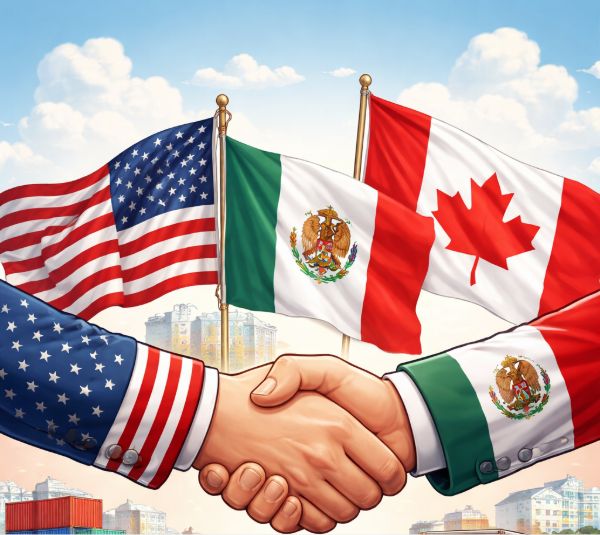
The 2026 review of the United States-Mexico-Canada Agreement (USMCA) will trigger a formal trilateral process by which Mexico, the United States, and Canada will assess the performance of the treaty and decide whether or not to extend it for a further 16 years. As the review will take place at a time when there is significant debate over nearshoring, rules of origin, and competitiveness, particularly in the context of supply chains adapting to the post-pandemic and geopolitical reordering, the USMCA 2026 review will be an important factor in trade certainty, investment confidence, and capital flows into Mexico and the region as a whole.
There is some guardedness in multinational companies, but the baseline for most observers is one of continuity. The logic goes that the economic importance of the treaty — along with deep productive integration between the three countries — makes a rupture unlikely and instead points to targeted adjustments. Mexican government statements, private sector forecasts, and expert commentary in various recent economic forums have been mostly aligned in saying one thing: that stability and predictability in the treaty is essential for nearshoring momentum and for avoiding caution on long-term investment decisions.
Details of the 2026 Review Calendar
The treaty lays out a timeline for the process. The three countries will, in a formal process from January to July 2026, review the performance of the treaty and will make a decision whether or not to extend it. It should be noted that this process is not an automatic sunset. Rather, it would trigger a process that would reaffirm commitments, modernize the treaty, and extend it for a further 16 years. Mexican President Claudia Sheinbaum has said Mexico would come to the table from a place of strength in view of solid macroeconomic numbers in Mexico and positive early signals from the United States. For companies and investors doing business in North America, the USMCA 2026 review will represent a landmark: in addition to the legal assessment of performance, it will be a strategic moment that will have implications for corporate planning and investment horizons.
Mexico and the Competitive Edge of Nearshoring
The most important opportunity associated with a successful USMCA 2026 review will be the further acceleration of nearshoring, meaning the relocation of production of manufacturing and services closer to the North American market. In the quest for more resilience, cost competitiveness, and logistical reliability, many global companies are recognizing Mexico’s geographical and productive advantages in terms of proximity to the United States and integration into its supply chains. Entering into the USMCA 2026 review process, Mexico can tout advantages such as:
- Deep integration in regional value chains, especially automotive and electronics.
- Competitive manufacturing costs and an increasing technical talent pool.
- Growing logistics infrastructure, with strategic development corridors.
- Proactive participation of the private sector through consultative working groups.
Business organizations in Mexico have calculated that Mexico could be looking at exports of more than $700 billion in 2026, if policy consistency is maintained and trade rules remain predictable.
Sensitive Regulatory Topics in the Context of the 2026 Review
While broad support for the treaty is widely assumed, the USMCA 2026 review will not be without issues. Energy policy continues to be one of the most high-profile topics, as investors will look for clear regulation and more competitive pricing for industry to power continued expansion. Rules of origin, especially in the automotive sector, will also be a key focus, with manufacturers looking for clarity on the rules in order to manage the cost of compliance while remaining price competitive. In addition to energy and rules of origin, there are new issues such as e-commerce regulation, cross-border data flows, cybersecurity standards, and artificial intelligence governance and regulation that will become increasingly pertinent to any modern trade agreement. This will be layered on top of the evolution of US trade policy, which has seen the United States turn to tariffs as an economic negotiating tool in addition to China’s growing role in many supply chains. Mexico will be looking to balance a diversification push with maintaining North American integration as a top priority.
Sectoral Impacts of the Review
- Automotive: changes to rules of origin would have an impact on sourcing strategies and plant investment.
- Agriculture: Sanitary and phytosanitary standards are a key determinant of cross-border flows.
- Manufacturing and electronics: push to regionalization may boost component production.
- Logistics and infrastructure: would require continued investment to keep up with expected higher volumes. Ports, highways, and rail corridors in particular.
Small and medium enterprises (SMEs) can also gain from the review, if it brings simplification, digital customs processes, and capacity-building programs to better connect SMEs and local suppliers with multinational production value chains.
Outcomes: Stability to Stress Test
A number of outcomes can be considered as realistic. An optimistic scenario would be an extension of the treaty with limited changes to strengthen investor confidence and accelerate nearshoring. The baseline (conservative) scenario would likely involve a targeted renegotiation focused on maintaining trilateral productive integration while resolving specific irritants. An adverse scenario would see higher levels of political posturing and possibly some localized disputes, but with a still low probability of a treaty collapse. Former USMCA chief negotiator Kenneth Smith Ramos has made the point that this is no symbolic process — the treaty renegotiation is technically complex and politically sensitive and would need to be carefully managed by all three governments.
Mexico’s Preparations for the 2026 Review
For Mexico’s part, the challenge would be to approach the USMCA 2026 review process with a well-coordinated national strategy. This means:
- Dialogue with the private sector must be strengthened.
- Legal and regulatory certainty, especially in the energy sector and permitting, must be provided.
- Skills training would have to be ramped up to meet industry needs.
- Customs processes, ports, and logistics corridors would have to be modernized.
Done well, the process can become a catalyst for attracting more high-value manufacturing, technological adoption and increasing Mexico’s share in the participation in advanced industries such as electric vehicles, medical devices and aerospace.
Conclusion: 2026 Could be a Transformative Opportunity
In many ways, 2026 will be a year of transformation in the economic integration of North America. For investors, the USMCA 2026 review is less about renegotiating the rules of the game, but more about a confirmation of stability over the long term. For governments, the USMCA 2026 review would be a moment for modernization of the treaty as well as building trust. If Mexico can continue to address regulatory uncertainty, increase transparency, and use its competitive advantages, then 2026 could become less of a moment of uncertainty and more of a springboard for sustained growth and deeper integration into global supply chains, making the economy stronger in both the domestic and North American contexts.