
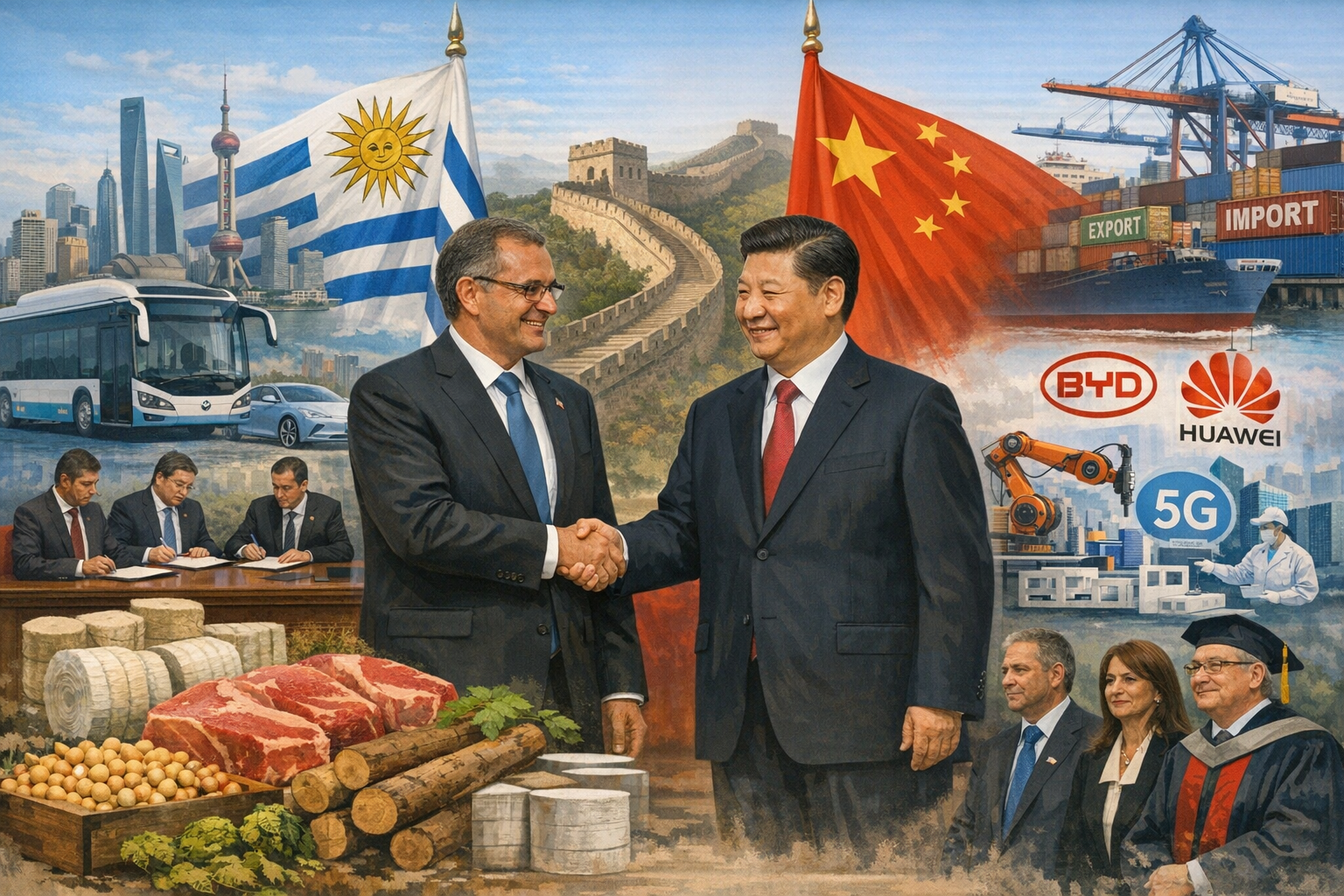
President Yamandú Orsi is leading an unprecedented delegation as part of the 38th anniversary of the restoration of diplomatic ties between China and Uruguay, underscoring the strategic importance of the bilateral relationship.
One out of every four dollars that enter Uruguay through goods exports comes from the same destination: China. For 14 years it has been the main buyer of Uruguayan products and has been a key player in the rise in living standards the country has experienced so far in the 21st century—a process closely and directly linked to the Asian country’s demand for raw materials such as beef, dairy products (which have seen a significant slowdown since 2022), pulp, wood, and soybeans.
The “commodities boom” spread across South America, and Uruguay was no exception. During the so-called “progressive era,” the region went through a cycle of prosperity closely tied to the “Chinese miracle,” driven by a profound shift toward openness in China’s economic and social policies following the 1959–1961 famine and the implementation of reforms launched in 1979—until then, China’s Constitution prohibited foreign investment. The modernizing reform involved the creation of special economic zones, the dismantling of state agricultural communes, the privatization of companies, and even the imposition of the one-child policy during those years (abandoned in 2015).
As international trade began to open up between the 1970s and 1980s, under the leadership of Deng Xiaoping, China offered the industrialized world an abundance of cheap labor. The “factory of the world,” while retaining authoritarian traits in its single-party system of government synonymous with the State (the Communist Party of China), lifted hundreds of millions of people out of poverty and, after 45 uninterrupted years of economic growth at an average annual rate of 9%, eliminated extreme poverty, as announced by President Xi Jinping in 2021.
In parallel, Uruguay multiplied its Gross Domestic Product (GDP)—from around US$20 billion to more than US$70 billion today—with the Asian power already consolidated as its main trading partner, a role it has held for more than a decade as the largest buyer of Uruguayan products and the second-largest supplier of goods. This transformation has placed China and Uruguay at the center of one of South America’s most stable and enduring trade relationships.
In 2025, according to the latest Uruguay XXI report, which includes free trade zones, exports to the Asian country totaled US$3.493 billion. Soybeans led the export basket to that market, followed by pulp and, in third place, beef, with shipments close to US$724 million.
“China consolidated its position as Uruguay’s main trading partner, now representing 26% of total exports, up from 24% the previous year,” the agency concluded in its latest foreign trade report.
After the restoration of diplomatic relations in 1988, during the first presidency of Julio María Sanguinetti, political and commercial ties with China grew uninterruptedly, especially during the three administrations of the Broad Front (2005–2020), and continued to do so under Luis Lacalle Pou, to the point that a Free Trade Agreement was pursued without success (a feasibility study was carried out).
A record-setting tour
Within this historical framework and the current context, the government of Yamandú Orsi—aware of China’s importance to Uruguay—is leading the largest delegation ever to travel to the Asian country: more than 150 people, including mayors, business leaders, union representatives, ministers, deputy ministers, and dozens of senior officials, with the aim of further deepening bilateral relations between China and Uruguay.
Ahead of the start of official activities, Foreign Minister Mario Lubetkin said that the official visit had been scheduled to take place within the first year of government. “There is a striking presence of business leaders in the delegation. No presidential foreign visit comes close to the number of private-sector actors on this trip. That alone is already a very strong signal. This is not just a public initiative; it is public-private. The government is seeking to hold business matchmaking rounds between Chinese and Uruguayan companies in order to move forward in economic and commercial development,” the foreign minister explained, illustrating the scale of the diplomatic mission.
President Yamandú Orsi will meet with President Xi Jinping on Tuesday, February 3, 2026 —a symbolic date marking the 38th anniversary of the resumption of diplomatic ties—in what will be the high point of the visit, which will run through Saturday, February 7, 2026.
Focus on innovation
With a large number of agreements set to be signed, according to official announcements, the government highlighted visits to companies and industrial plants, but placed particular emphasis on technology and innovation. The top authorities of the University of the Republic, including Rector Héctor Cancela, are part of the presidential mission that will visit Beijing and Shanghai, where agreements will be signed in biotechnology and artificial intelligence with seven universities and with the telecommunications giant Huawei.
In terms of purchases, the main products imported from China are closely linked to the technology sector. Mobile phones (Antel is one of the main importers), computers, Smart TVs, and, more recently, electric vehicles are among the products China sells most to Uruguay. In this context, Industry Minister Fernanda Cardona will remain one additional day beyond the official delegation to hold meetings with executives at BYD, a multinational known for the manufacture of electric vehicles and charging stations. Juan Salgado, president of Cutcsa, is also part of the mission, as the company advances the electrification of its bus fleet with Chinese-made units.
In 2025, imports from China exceeded US$3 billion, with electric vehicles at the forefront, according to data from the National Customs Directorate.
Business leaders consulted noted that beyond the roughly 30 protocols or agreements expected to be signed, the value of the visit also lies in strengthening personal and informal ties that often facilitate long-term cooperation.
The government also reported that, in addition to ongoing discussions on tariff improvements—at a time when Uruguay is preparing to implement the TEMU tax—the agenda includes academic exchange, cooperation in science and technology, dairy products, poultry, public broadcasting (Channel 5), the National Emergency System (Sinae), and the signing of an agreement with the Pasteur Institute related to a vaccine against ticks.
A visit by an adviser very close to Xi Jinping
In November, China’s Vice Premier Ding Xuexiang— the sixth member of the Standing Committee of the Political Bureau of the Central Committee of the Communist Party of China and a direct adviser to Xi Jinping—visited Uruguay. During that visit, the Chinese government expressed its intention to accelerate progress on several agreements signed in 2023 under former president Luis Lacalle Pou.
For China, the difficulties in advancing an agreement lie with the regional bloc
The Uruguayan delegation’s visit takes place amid growing tension in the global trade and technology dispute between the world’s two leading powers, following an escalation of tariff and geopolitical measures promoted by U.S. President Donald Trump in response to China’s expanding global influence, particularly in Latin America.
Within Mercosur—which recently concluded a historic agreement with the European Union—member countries hold divergent positions regarding relations with both China and the United States. As a result, the possibility of advancing a free trade agreement with China, whether bilaterally or as a bloc, appears distant.
Paraguay maintains diplomatic relations with Taiwan; Argentina aligns closely with the United States while preserving pragmatic ties with China; Brazil faces pressure from the Federation of Industries of the State of São Paulo; and, beyond the bloc’s structural asymmetries, the current Uruguayan government has shown little appetite for pushing forward a free trade deal.
China’s ambassador to Uruguay, Huang Yazhong, addressed the issue recently in an interview on Canal 10. “We are always willing to develop bilateral or multilateral free trade relations. But in this specific case, the difficulty is not in China. It is an issue that Mercosur must resolve among its member countries. China always maintains an open position,” the diplomat concluded.